

There has been significant media scrutiny and commentary in recent weeks in relation to the Geelong Football Club and a secret concussion waiver that released them from any legal risk for any future concussions/head trauma to one of their players.
While this agreement has been widely criticised, it raises a question for our community about how formal reactions and consequences compare with safety issues.
In June this year, the ABC’s Four Corners revealed that thirty-three Australian Rules players, including 19 professional and semi-professional footballers, have been diagnosed with the degenerative brain disease chronic traumatic encephalopathy (CTE), exposing the scale of the AFL’s brain trauma crisis. These alarming findings, compiled by the Australian Sports Brain Bank, included high-profile players who died in their 20s, 30s and 40s.
This investigation exposed the scale of the AFL’s CTE crisis and triggered an ongoing WorkSafe Victoria investigation.
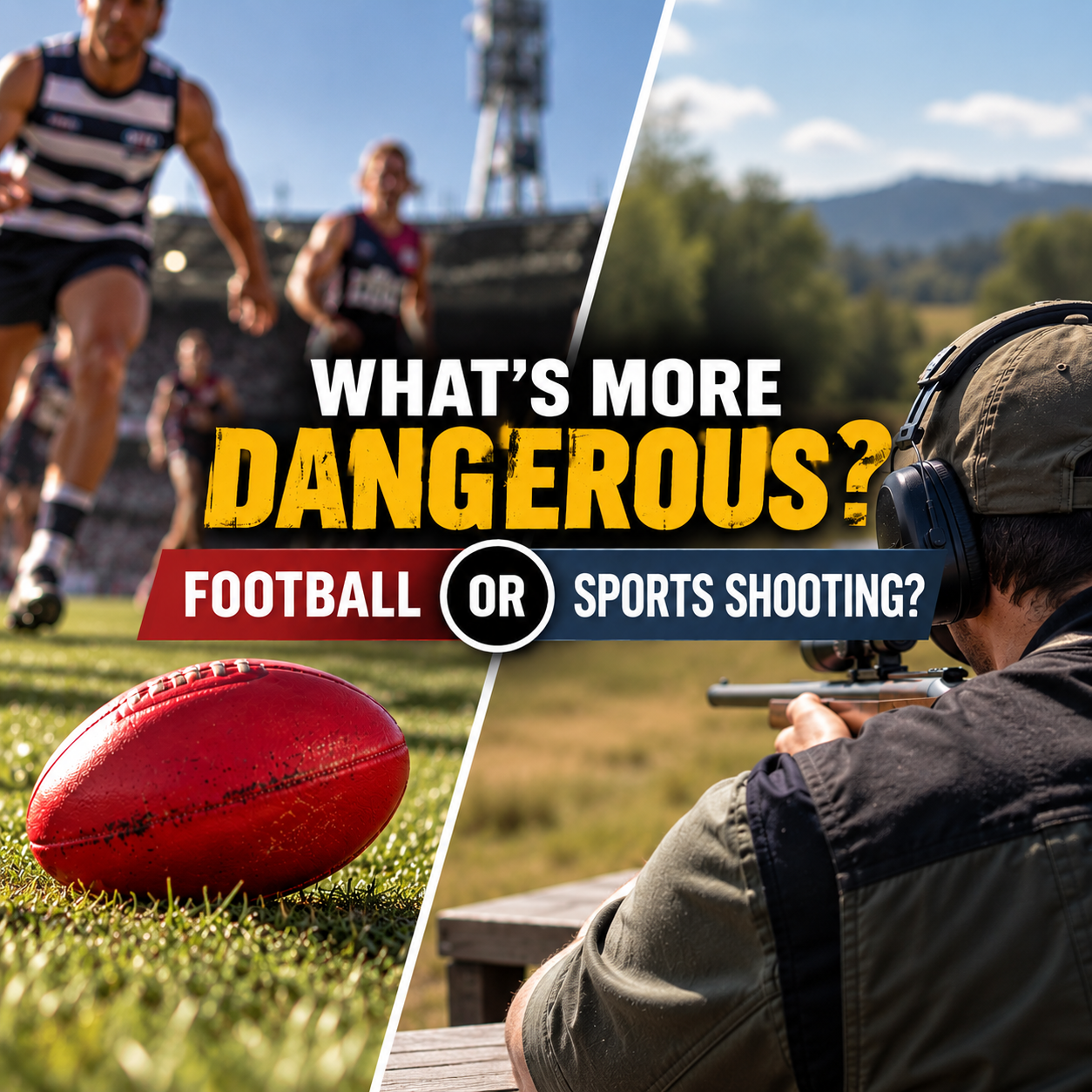
This makes you wonder – is football more dangerous than shooting? And if so, what is the difference in public policy and regulatory impact between the sports?
Many people outside of the SSAA community would be potentially outraged at the mere suggestion of this question, but really – what is the comparison?
It would take a proper academic to interrogate all the available data in relation to AFL at all levels, and all firearms use (for sport and other purposes) right across the nation, but there’s still a lot of available information to have a good look at.
Federal government data estimates in 2024-25: 589,100 Australians aged 15 and over played Australian rules football. During this same period, there were about 5,400 injury hospitalisations attributed to the sport, with the second most injured body part across all ages being head/neck (24% of injuries, just under 1,300 cases).
This is also reflected at the elite level, where concussion was reported as the second most common injury in the most recent AFL season injury report (2023) with an incidence of 4.26 injuries per club per season, or 77 across the competition.
Just to be clear, what we’re talking about here is a lot of head injuries right across the community, in one of the most popular sports in the nation that at best cause short-term changes to your neurological function, and at worst can cause potential complications such as:
- chronic traumatic encephalopathy (CTE) — a degenerative brain disease that is linked to repeated head injuries
- cognitive impairment — which causes problems with memory, attention, and executive function
- mood disorders — such as depression and anxiety
So, from this, let’s say that AFL football at all levels is responsible for its fair share of head and neck injuries.
From that federal government report in 2024–25, the following data details sports injury hospitalisations across all sports in Australia, with shooting sports not even making it onto the table – even compared to recreational walking.
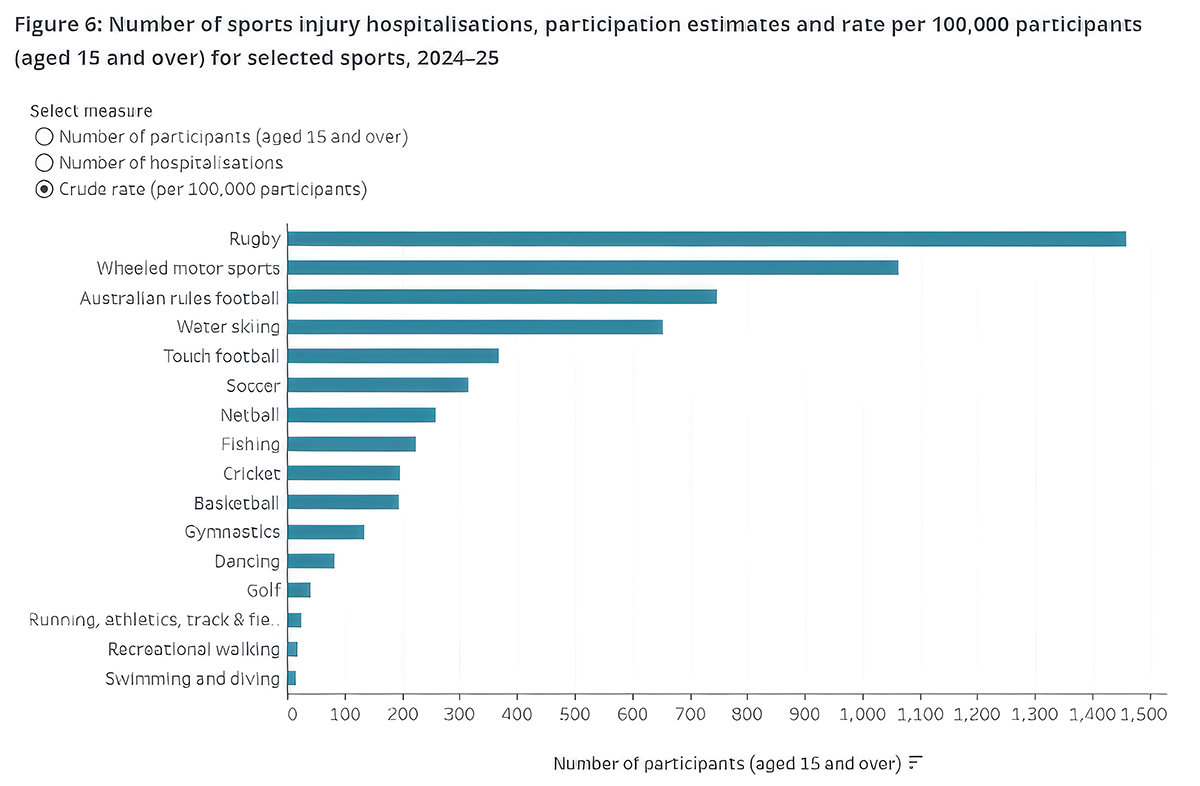
This brief compilation shows that shooting is a safe sport, and it’s not due to a lack of participation.
In fact, the 2026 federal government AUSPLAY data included adult organised participation of 24,183 for ‘shooting/field’, and 25,352 for ‘shooting/range’, meaning thousands of Australians in 2025 safely participated in shooting sports.
While many others may want to say, “well that’s not the only use of firearms, or the only cause of firearm harm in the nation”, that’s true, but it also must be considered that shooting sports are formally recognised across the country as legislated “genuine reasons” to have firearms. It also has to be viewed in light of the formal data contrasting injuries to participation in our sports.
In saying all of this, the SSAA isn’t seeking to say that the use of firearms doesn’t include risk, or that all AFL players should play in a 10-inch covering of cotton wool. What we are saying it that we want our members and lawful firearm owners to be treated with the same consideration in relation to community safety as others are.
In the last few months alone, it has been highlighted through extensive evidence and reporting that playing AFL carries with it a risk of serious head injury and death, and one of the most prominent clubs at the elite level has signed a secret agreement to seemingly relieve them of liability related to head trauma for one of their players.
The response to those two matters alone has been a single state based safe work agency investigation which is “on going” and the AFL appointing an independent legal figure to investigate Geelong’s concussion contract clause saga. Imagine if safety in shooting sports was subject to such leniency.