
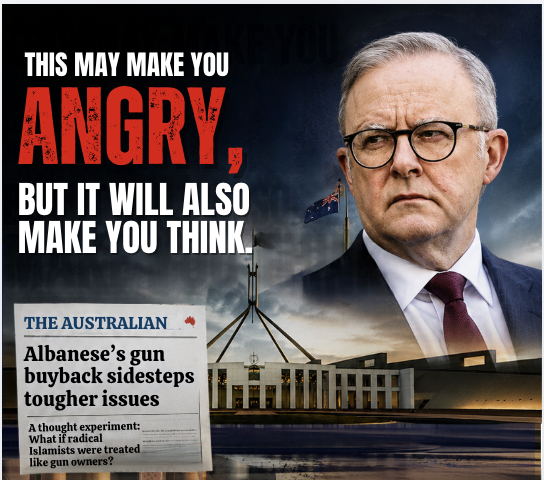
Today, The Australian has published a piece that a lot of you may find interesting (paywalled), contemplating the scenario where Anthony Albanese treated radical Islamists in the same way he has treated Australian gun owners.
While the Prime Minister has made a habit of talking about the importance of social cohesion, the Australian makes the poignant but sad/frustrating observation that he has not demonstrated the intestinal fortitude to actually get this done.
In considering this, the Australian made the primary observation that a gun buyback sidesteps the requirement for the government to tackle the tougher issues of radical ideology, antisemitism and political pressures.
In analysing the government’s approach to firearm reforms, the Australian posed the question – how radical Islamists would be treated if they had been exposed to the same attitude and discourse as firearm owners? They would be told that:
- they have no automatic right to be a radical Islamist
- the nation cannot allow the demands of a “noisy minority” to prevail over the right of all Australians to live safely in a free society
- the government will strictly regulate the preaching of Islamist ideology, ensuring that unlicensed radical Islamists face criminal prosecution
- the government will create a national register, and all radical Islamists will have to apply for a licence – many applications will be refused because the bar will be high
- the absence of a criminal history is not in itself sufficient to qualify for a licence
- all related religious materials must be kept in a lockable container, with police ensuring compliance by random and regular inspections
As for criticism that the government did not consult the Islamic community about these changes, the government would simply say that consultation would not be necessary, as this is a commitment to………social cohesion.
The Australian acknowledged that this comparison could offend or be confronting to many; however, they were intentionally provocative, drawing a comparison to a cohort assessed as a threat to national safety, which is not characteristic of licensed firearm owners in Australia.
In drawing this comparison, which may be called crude and a dog-whistle, it demonstrates the absurdity of the government targeting a group (firearm owners) who are consistently demonstrated to be highly compliant with ongoing and thorough regulation – and also a group who are often perceived as being conservative.
In tying a bow on the irrationality of the government’s firearm reforms, the Australian also re-emphasised the fact that most of the states have rejected the scheme, but in putting the scheme in place, the government puts its priorities on show: political expediency, giving the impression that they’re doing something to prevent terrorism, and blurring the cohort that is largely responsible for the actual harm.