


Brendan Atkinson enjoys a top-end Japanese scope
Shooters contesting longer distance events are now spoiled for choice when it comes to selecting a high-quality scope. How much magnification? Whether to go first or second plane. Is illumination required? The list goes on. So the subject of this review is the Japanese-made Vortex Razor HD Gen III in 4-24×44 power, which has many of the features demanded by serious competitors.
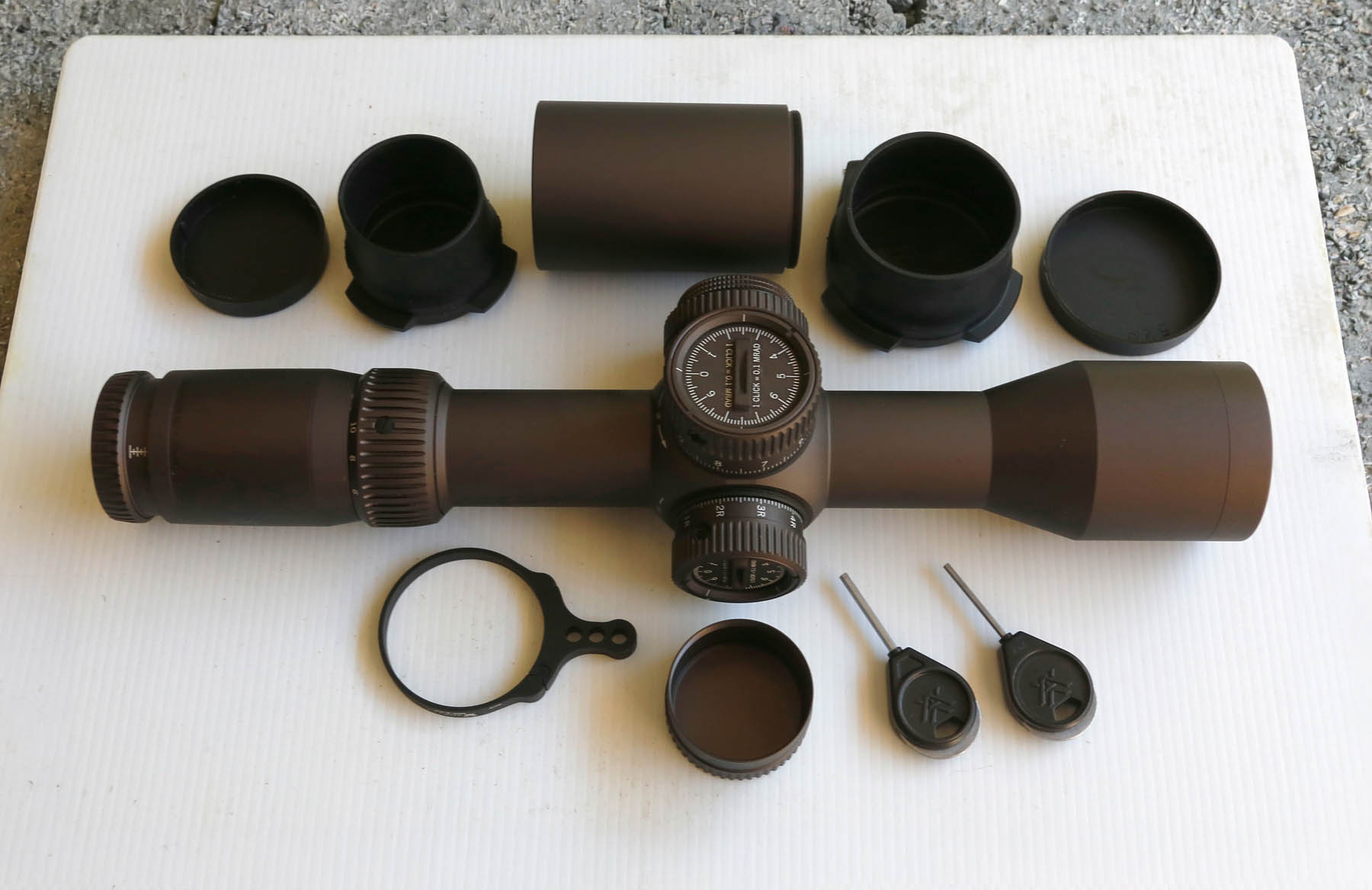
Opening the box reveals the scope along with a set of lens covers, a sunshade for the objective lens and throw lever for the power ring for those who prefer them. There are also a couple of Allen keys and a lens cleaning cloth. A highly comprehensive product manual contains everything you need to know about this scope, while there’s also a manual explaining the EBR-7D MRAD reticle and how to use it.
So let’s look closer at the main features of this model. It’s certainly compact at a mere 318mm in length and weighs .916kg, the main tube being 34mm which allows for plenty of turret travel. Looking at the scope from the front, on the left is a capped and lockable windage turret, while on top is the lockable elevation turret, which requires you to lift it up before attempting to rotate it. Once a setting is reached, just push it back down and it’ll stay there. On the right is the parallax adjustment knob. This dial also incorporates the battery compartment which requires a CR2032 battery for illumination of the reticle. One is supplied with a protective seal which must be removed to activate the system.
Moving towards the rear of the scope we find the magnification ring which requires a firm hand to turn it, though a throw lever is supplied and can be attached to make adjustment more accessible. At the rear on the ocular lens, you’ll find a fast-focus eyepiece with graduations marked out for quick reference.
This model features a First Focal Plane (FFP) which is preferred by many longer distance shooters. The main difference between first and second focal plane is that with the former, the reticle will appear to grow and shrink as the power changes, while the second focal plane stays the same over magnification alterations. The advantage with FFP is the sub-tensions used for holding over remain the same no matter what the power, which offers several plus points for an experienced shooter.
Vortex offer their Gen III in either Minute of Angle (MOA) or Milliradian (MRAD). For those unfamiliar with these, 1MOA is equivalent to 1.047” at 100 yards, whereas 1 MRAD is equivalent to 3.6” at 100 yards. The Gen III under review having MRAD means that at 100 yards, one click of adjustment will move the impact .36 of an inch or .1 MRAD.
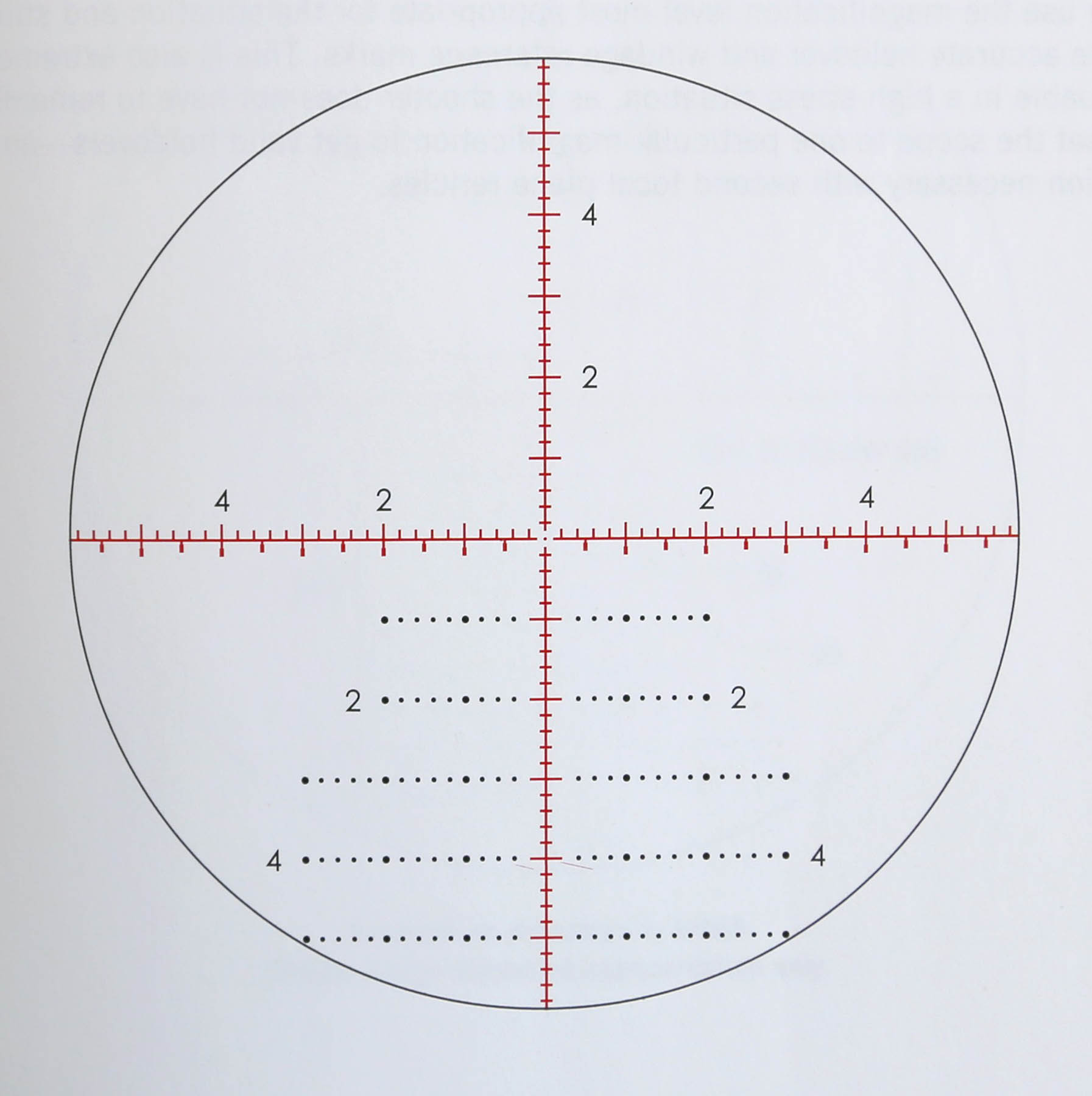
The reticle in this scope is the Illuminated EBR-7D MRAD, referred to by some as the ‘Christmas tree’ reticle for obvious reasons when first seen. The reticle is laser etched on to a glass surface to ensure accuracy of the sub-tensions. It looks extremely ‘busy’ but, once you get used to it and what it can offer, everything falls into place. It can be used for ranging a target and this is fully explained in the owner’s manual. It involves a series of formulas which require you to know the height of the target and, from that using the sub-tensions in the scope, an accurate distance to target can be obtained. Coupled with this of course, you have to know your bullet drop with the cartridge being used to ensure hits at distant targets. At the lowest power setting it’s a little difficult to see the reticle, though I imagine with experience this shouldn’t present a problem. Illumination of the reticle has variable intensity to suit the user. There are 10 levels of brightness to choose from and once you settle on a desired intensity, it can be locked in for future reference.
So how does it perform in the field? I took the scope down to the Monarto silhouette range in South Australia, which has a clear 500m to the target mound. I must say the clarity of this unit is right up there with the best I’ve seen. Targets at 500m were no problem and, at full magnification, .30-calibre holes could be seen with some concentration. The splash plates for metallic silhouette shooting stood out well, allowing the sub-tensions for hold-off to be used when sighting-in at this distance. I’d certainly recommend this scope for such disciplines as Precision Rifle Series and Metallic Silhouette, where hold-over and ‘knowing’ your scope are essential requirements.
Conclusions
This is an excellent example of what’s now on offer for the long-distance shooter. With the current popularity of such disciplines as Precision Rifle Series, demands for top-quality equipment is paramount. Naturally, quality such as this commands close to top dollar and I’ve seen this scope advertised in the region of $4500 but, as I always recommend, look around for a competitive price.