
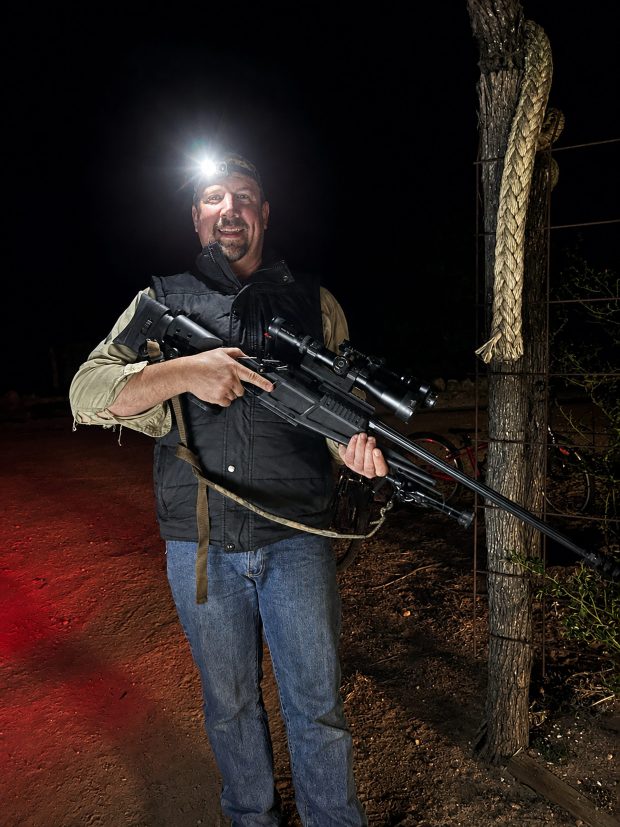
You only need to mention the nickname ‘Steelo’ to many of our members and they know exactly who you’re talking about. Bevan Steele would be best known for his business Steelo’s Outdoors in rural Western Australia, his YouTube channel @steelosoutdoors and his efforts in advocating for the needs of WA shooters and firearm traders. He sat with Charlotte Fox to talk about his background in the police and what led him to where he is today.
Tell me a bit about yourself?
I grew up in rural Western Australia in the Wheatbelt region and from a young age had an affinity for V8 cars and shooting. Three-quarters of my first car was paid for by shooting rabbits as I spent a lot of time working out how I could put big engines in little cars. Considering those skills, when I thought about where I’d find a job where I could play with cars and guns, I concluded the answer was either the Army or the cops. I opted for the latter and joined as soon as I was eligible aged 19.
How did you get into hunting and shooting?
My father taught me and anyway, in the country there are limited forms of entertainment. My granddad would set up tin cans and we’d have a competition between the cousins, who could shoot most cans and from the greatest distance. It was also a great way to bring all the cousins together, so they’re some of my fondest memories. It’s not so much about shooting, more interaction with family and building connections and memories across genders and generations.
How did you go in the police force?
I went through the Academy, ticked the boxes and went bush straight away for four years, until I decided I wanted to get into the crazier side of policing and high-risk tasking. Considering I’m from the bush and a bit of an adrenaline junkie, I tried out for the Tactical Response Group (TRG) aged 23, managed to get through the selection process and was posted to Perth. For those who don’t know, the TRG is responsible for high-risk tasking such as counter-terrorism response, sieges and incidents with high-risk firearms involvement.
I stayed with the TRG for more than eight years until I was promoted and came back to the bush. Then I went on a long-service trip around Australia with my partner Heidi, who was also in the police. On that trip we thought: “You know what, we’re going to do something different,” and decided to buy a gun shop for sale in Narrogin, where we were policing at the time.
How was starting out in that business?
At that time, 13 years ago, I stepped out of my police role as a government employee one Friday and had absolutely no experience or knowledge of the industry, sales systems, social media, yet opened our doors the next day. Despite that, we saw the need for a more hands-on approach with the existing customer base and, to assist in that, wanted to start going to agricultural field days. We were surprised at how reticent those organisations were initially at having a firearms business at their events.
At that time I also became more involved with the SSAA. I found my police experience gave me great insight to be able to engage with law enforcement agencies and other government stakeholders in relation to policy and regulation. It also opened my eyes to all the work the SSAA does behind the scenes to look after members, which a lot of people don’t see.
How has that linked in with your role as president of WA Firearm Traders Association?
At the time I was talking with Paul Fitzgerald (SSAA WA president) and realised we needed a unified approach with clubs and interest groups, to achieve the most effective advocacy. On the back of that conversation we ended up forming the WA Firearms Community Alliance. While we’ve had legislative changes in our state we weren’t able to prevent, it’s been a highly successful advocacy model to at least have a unified, single voice. It’s also important as the industry we work in is highly technical so we want stakeholders, like governments, to be able to talk to us and have confidence in the advice we’re providing.
Describe your business, Steelo’s Outdoors.
Initially we had the word ‘guns’ in the name but found it was detrimental to online algorithms, so we amended it. When we took the business on we’d a lot of sporting goods and a little bit of firearms, though over time we’ve flipped that. With our time spent travelling around WA on our long-service trip, we saw a real gap in the market to sell decent camping equipment. So we’re now essentially experts in firearms and camping, like BCF crossed with a gun shop.
Being independent we stock the things we want, as opposed to being dictated to by a chain for both camping and firearm products. That enables us to work with clients to really target what they need and want, then provide them with that. It also lets us be a lot more tailored and authentic in our business to provide a service and not just products.
What challenges have you faced running a firearms-related business?
There are so many. It’s such a difficult environment in ways most consumers probably wouldn’t fully understand. A couple of examples include combatting misinformation and financing. With so much available online these days, we find a lot of customers believe they understand the products that’ll suit them best. Yet they’ve actually been misled by influencers who sounds convincing but haven’t provided the best information.
This means you have to help them understand more accurate information and re-direct them to products that’ll best serve their goals, or ones not limited by import restrictions. In relation to finance, a lot of people may not realise the banking sector can’t finance firearm shops in Australia. This is because we’re inadvertently impacted by their international agreements not to fund terrorism. That leads to challenges in obtaining insurance, so it’s an incredibly constrained environment.
You have a YouTube channel – what are you trying to convey?
Like everyone else it’s a chance to promote our business, though we also do a live stream every Thursday which started in fairly entertaining fashion. Our first was a bloke showing us how to use one of those folding shower tents. I filmed and streamed, it went really well, so I looked around the shop and realised I could do the same with many other products.
So we do a Thursday night ‘live’ every week, where we discuss contemporary issues such as WA firearm legislation changes, look at products and talk through anything else relevant to the industry. We’ve people dialling in from all over Australia and up to 8500 online, listening to us have a chat from our little country town. We’re also pretty authentic with content. I’m often fairly unprepared in planning what I’ll talk about, though that can also be very entertaining.
Has that impacted how you engage with stakeholders and politicians?
Being open and authentic goes a long way. I had one individual who was a stakeholder and had a bad experience in his youth, which led him to disliking guns. I offered to take him to a range, where I walked him through a number of firearms and committed to being 100 per cent honest with any questions or concerns he might have.
From that I realised stakeholders and politicians are just like everyone else, where you can only understand what you’ve been told. If they’re hearing information which maybe isn’t correct or is misleading, how are they supposed to know any different? That’s why it’s important to invest in those relationships and have a single, unified and consistent advocacy voice as much as possible. It’s also important our voice is driven by people with knowledge and skin in the game.
Any special memories from your time in the TRG?
You end up dealing with some really sad tasks. I remember we were called out to look for a missing person who’d wandered off heavily disorientated from diabetes, though sadly we weren’t able to find him in time to save him. Having said that, there are also some jobs which were highly entertaining. One of the best experiences was a brainchild of mine, which was a project on how to stop vehicle-borne improvised explosive devises (IEDs).
The serious side was I had to write a white paper to report our findings. To trial and test our strategies I got the go-ahead to build a remote-control car we could shoot at. Among the many things we’d to work out was making sure we complied with rules of engagement, then when’s the best time to shoot someone in that scenario? If they’re in a vehicle-borne IED and driving into a crowd, when and where is the best option to shoot?
To start the ball rolling I bought a couple of vans and a little 4½-ton truck and drove them to my dad’s property. I spent a week basically shooting every gun and dissecting the engines to see what would happen when they were shot. We were looking for things such as how many times it took to shoot it, at what speed and how long it took the car to stop under its own steam. On top of that I had to design a car to run remotely. It’s one thing to shoot a stationary car but we had to safely test things while it was moving.
I can tell you, building it was a challenge. I initially spoke to a WA university and asked if they could help but they laughed at me on the phone. So I approached our internal police bomb unit. They told me: “When the gear breaks we send it back to the manufacturer to sort out,” so they were no good. In the end I went to a retail store in uniform, so they’d believe me when I told them what I wanted to do. The guy in the store still looked at me like I was crazy, though eventually we brainstormed all the parts and mechanisms I’d need to do the job. It was quite the process for both of us.
Then I went home to suburban Perth and started tinkering and tooling around, trying to make my car. Eventually I could swap a remote control device out of one car and put it into another in about 20 minutes, then drive the other car completely remotely. So I gave my sergeant a call on a Sunday night at about seven o’clock. I said: “Hey Robert, how you going?” He replied: “What you up to?” I said: “You know this remote control car thing? I’m driving round the block and I’m in the back seat.” He just said: “No bloody way, send me a photo!”