


Chris Redlich hails the superb Gen 2 budget Ruger
The biggest pig showed itself once again and, after closing the gap to less than 50 metres, it became clear I’d be needing more than one round. The following experience made me thankful for the rifle I was carrying and even more so for the fact it has a 10-shot magazine.
But how do you introduce a rifle which, by all appearances, looks like any other bolt-action, because the Ruger American Gen 2 Scout is ordinarily just another bolt-action rifle. So my challenge was to write an eye-catching intro to another rifle review and, if that opening paragraph has your attention, then read on because not many new guns afford me the same excitement as this one.
Differing somewhat from their flagship Model 77s with Mauser-type (controlled round feed) action, the Ruger American sports a three-lug push feed affair. As the Gen 2 designation suggests, it’s the second coming of what was already a highly popular American Gen 1, sporting upgrades based on customer feedback. If I was to take note of all the noise my mates had to make about the American, by all reports the Gen 1 is a highly accurate rifle.
I’d never used a Gen 1 so can’t draw comparisons, though what’s immediately appealing about the Gen 2 is its spiral fluted barrel. The test model Scout, being the shortest of the ‘American’ rifle family, has a chrome-moly barrel measuring 16” (406mm without muzzle brake) and the cold hammer-forged rifling has a right-hand twist of one-in-eight. To me that would be perfect for heavier bullets in the region of 62-70-grains, particularly with longer barrels. Yet distributor Nioa had supplied me with 55-grain Federals and reckoned I wouldn’t be disappointed (as I’d find out later, their in-house testing was spot-on with the short barrel).
I don’t see too much advantage to be gained with a muzzle brake for the 223 Rem, unless for the sake of consistency across the American models. The threaded muzzle would be beneficial though, if at some point down the track our authorities relax the laws around suppressors. Interestingly, Ruger have designated this rifle 5.56 NATO and although sharing similar dimensions as the 223 Rem, the former generates higher chamber pressures than its sibling cartridge. This says to me the machining tolerances and metallurgy of steel used in the US-made American is to a very high standard.
The action beds firmly to the synthetic stock via a milled recess mating with an integral bedding block system. Combined with its two action screws, they positively locate the receiver while providing a full-length, free-floating channel to the barrel. Although the American is meant to be a budget model, you can’t help but feel the pride Ruger feels by having their bold motif emblazoned on the left of the action.
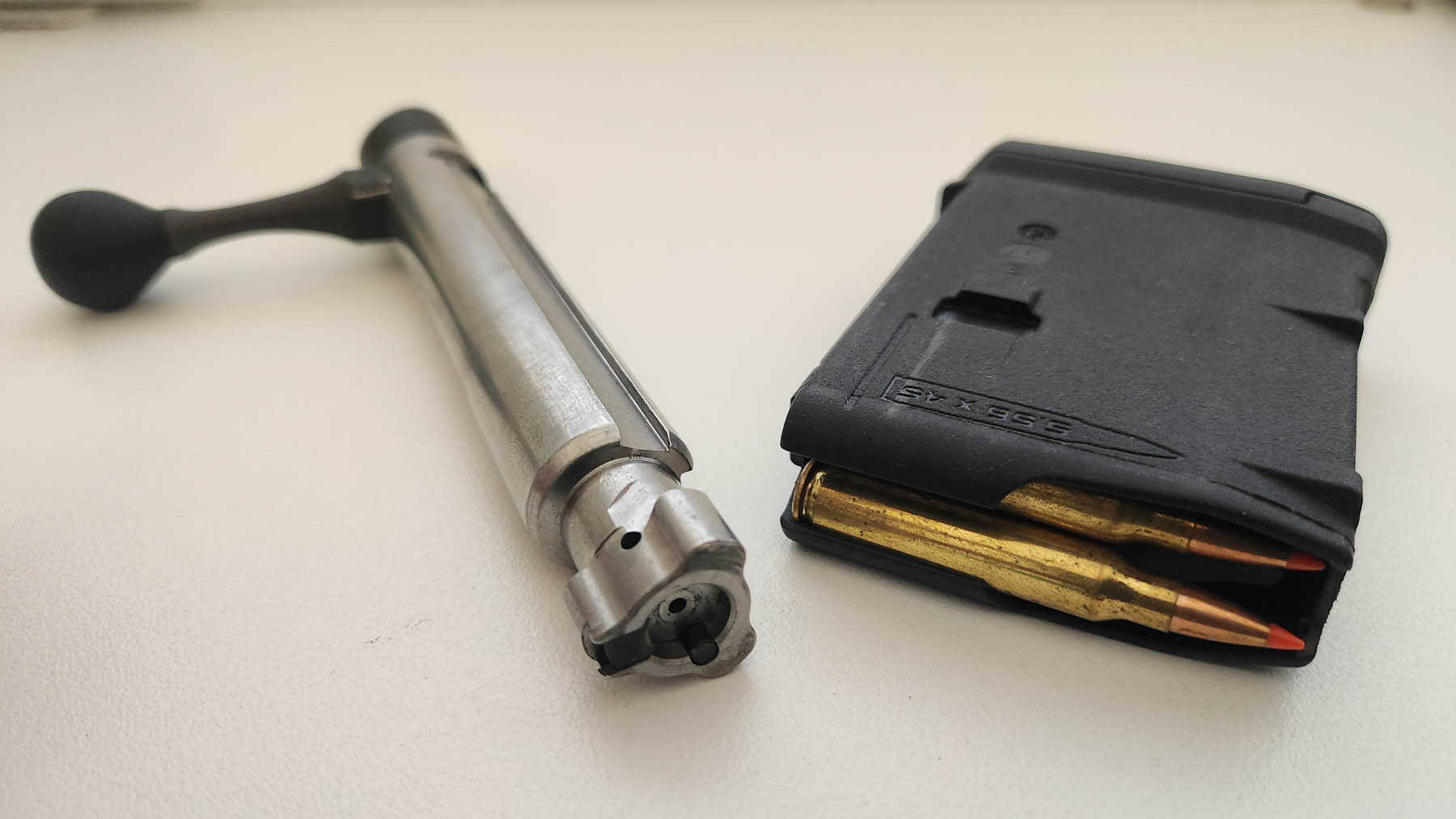
I believe if you’re going to build a budget rifle then build one which sells and, after one look and feel of the bolt, it further reinforced to me a quality product. The three-lug design enables a short 70-degree throw and while having a no-frills finish, the CNC-machined stainless steel bolt moved smoothly through the entire action cycle, while the large claw and plunge ejector removed and threw spent cases clear.
Despite its removeable large bolt knob and rear shroud made from not so glamorous plastic, they account for not much in overall weight reduction. The inclusion of a Picatinny rail on all American models is welcome and proves Ruger have built these rifles for utility and versatility. And protecting this utility rifle from the elements is a deep metallic grey Cerakote finish on all steel components.
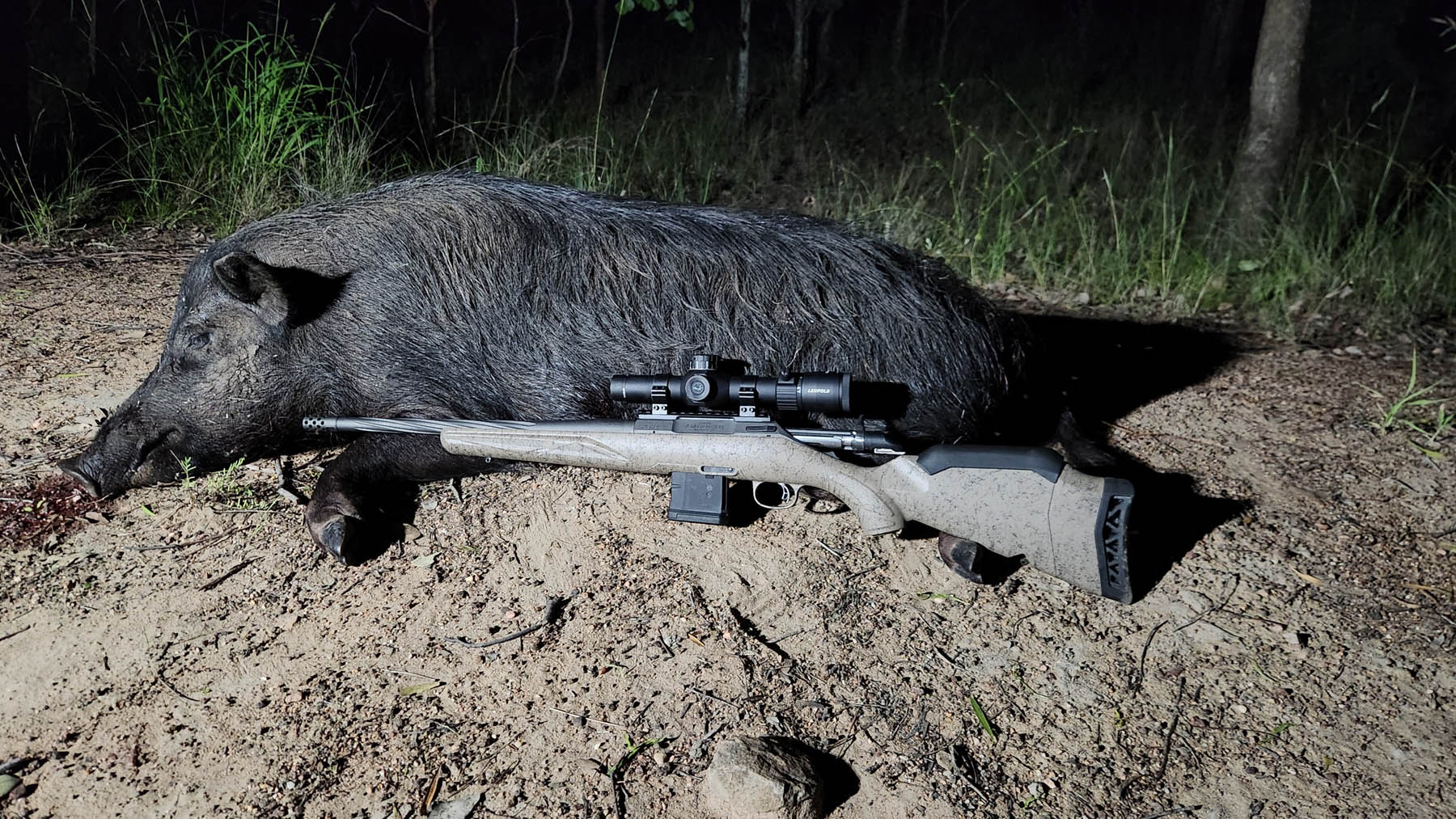
The polymer composite stock is all business-like and the new grey splatter finish a welcome improvement on the original plain beige and olive of the Gen 1. The upgraded rippled lines of the new stock are contoured to promote a positive grip during tough conditions, something I came to appreciate later.
Like its Ruger cousins the stock is ambidextrous but, instead of a straight comb as on the M77, it has a raised cheek-piece which connects nicely to the face. Ruger don’t supply the extra bits with the rifle, though the modular nature of the butt stock allows for customising with optional spacers. I found cheek height and length of pull on this one fine for comfortable offhand shooting.
Strange at first was the way the rear sling swivel was housed in the butt, though I’ve since learned Ruger have done this to provide an uninterrupted rear rest while using a bag. I couldn’t imagine an M77 timber stock with such an arrangement but it looks right at home on the American’s synthetic stock. The dual stack 10-shot Magpul polymer magazine is without doubt a fantastic inclusion. It clicks and retains securely while providing reliable feeding of additional rounds and the release button on the right is managed easily.
The Ruger Marksman trigger is reminiscent of Savage’s AccuTrigger and does take some getting used to. It’s a two-stage affair that’s user adjustable from three to five pounds. I’d rather the manufacturers would lower their pressures to at least a two-pound minimum but, for whatever reason, they don’t. Despite my grumbles it came set at 3.5lbs and I managed it well. The three-stage slide safety is at the rear of the tang and controlled easily by the tip of the thumb. All stages of safety clicked positively and are identified by clearly visible white lines (for one and two) and a single red line for ‘fire’.
With the rifle measuring 945mm and weighing just 2.9kg (unscoped) allows it to slot neatly into the ‘compact’ category. The Scout came paired with a Leupold Mk. 4HD 1-4.5×24. Leupold Mk. 4 scopes don’t need too much introduction and the quality of the glass speaks for itself. Although a fairly weighty affair, it’s straight objective and low magnification made it an ideal fit for the petite Ruger.
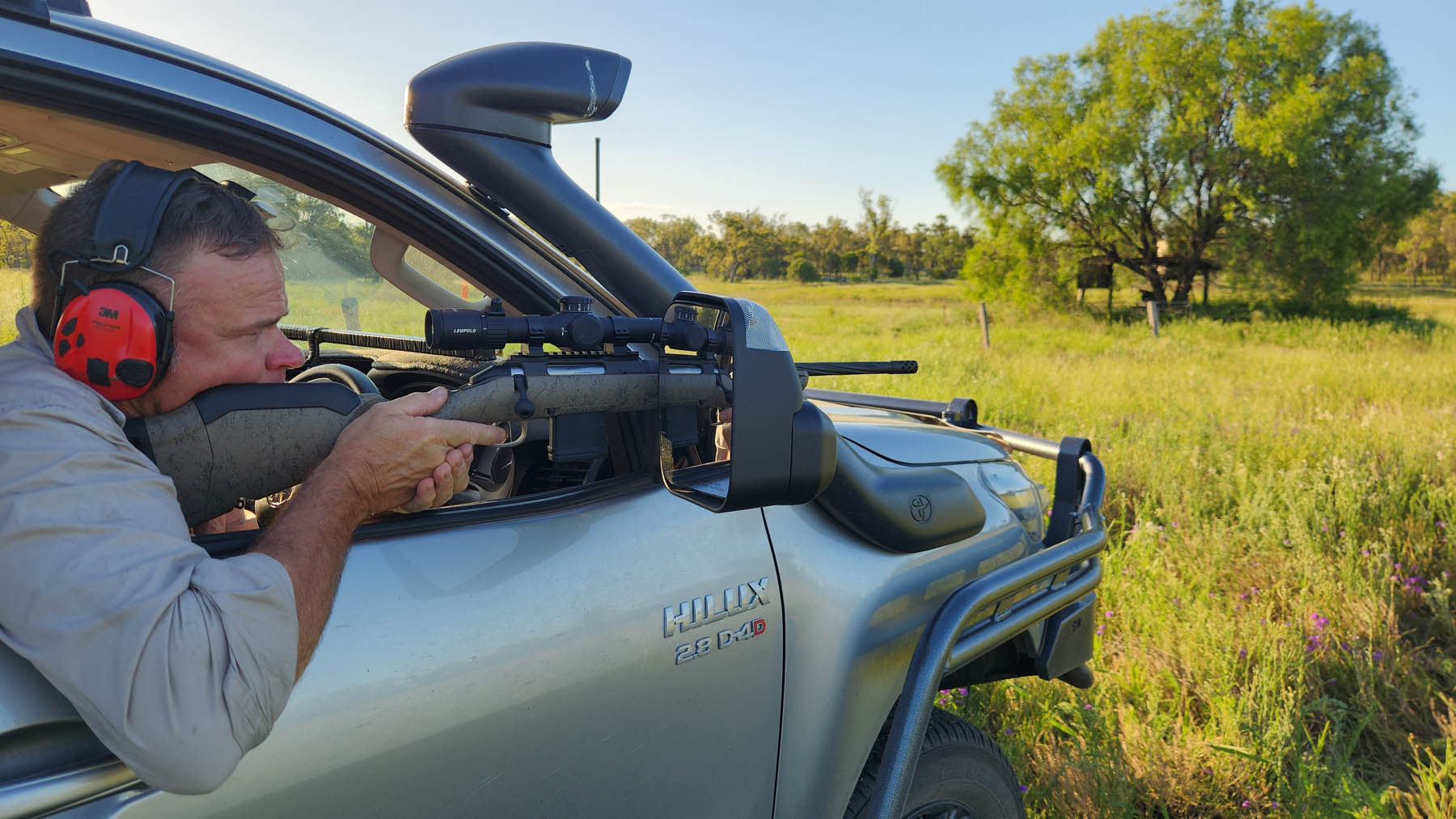
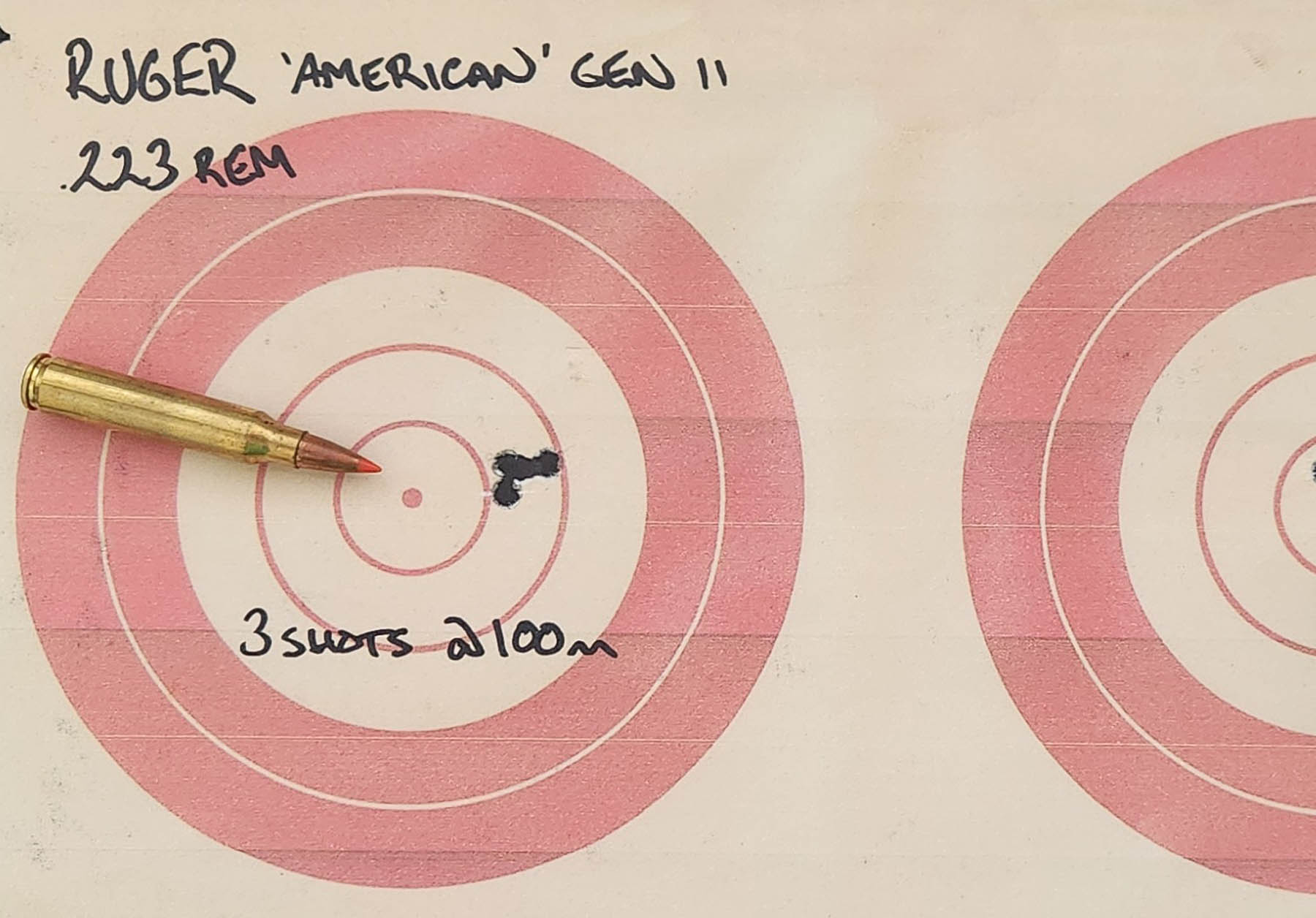
Lots of rain had seen an explosion of grass since I last visited my range and sadly the cattle hadn’t been doing their fair share of mowing. It was so high I couldn’t set up my bench, so I used my ute mirrors instead. I didn’t have high hopes for a tight group but boy was I in for a shock. My first three shots from a less than desirable ‘benchrest’ produced an eye-watering sub-half group at 100m, so apart from a tweak to the left I was ready to go hunting (and it proved Nioa were all over this one).
Let’s go to work
Fast-forward a few weeks to where this story began and I was helping my farmer friend Lyn with some machinery repairs, the American along for the ride in case a few ferals showed up. As the saying goes, one thing led to another and my ears pricked to a howl among the cattle bellows by the creek, so I concealed myself in the bank’s long grass with the Scout at the ready.
The wild dog and I exchanged howls and I knew it was inching ever closer. The wind swirled around me and after a standoff lasting almost an hour the dog fell silent. I locked away the rifle and walked to the gate then, lo and behold, a little further on it was heading towards the house. It had obviously caught my scent and fled down the creek for a safer exit.
The bright orange glow of its coat was a dead giveaway as the sun caught each step through the grass, so I gave chase using bushes for cover. She must’ve sensed I was on to her as she paused momentarily in the grass. I couldn’t go any further for fear of spooking the dog, so I stood still at around 100m with the American shouldered and locked on her ears in the scope.
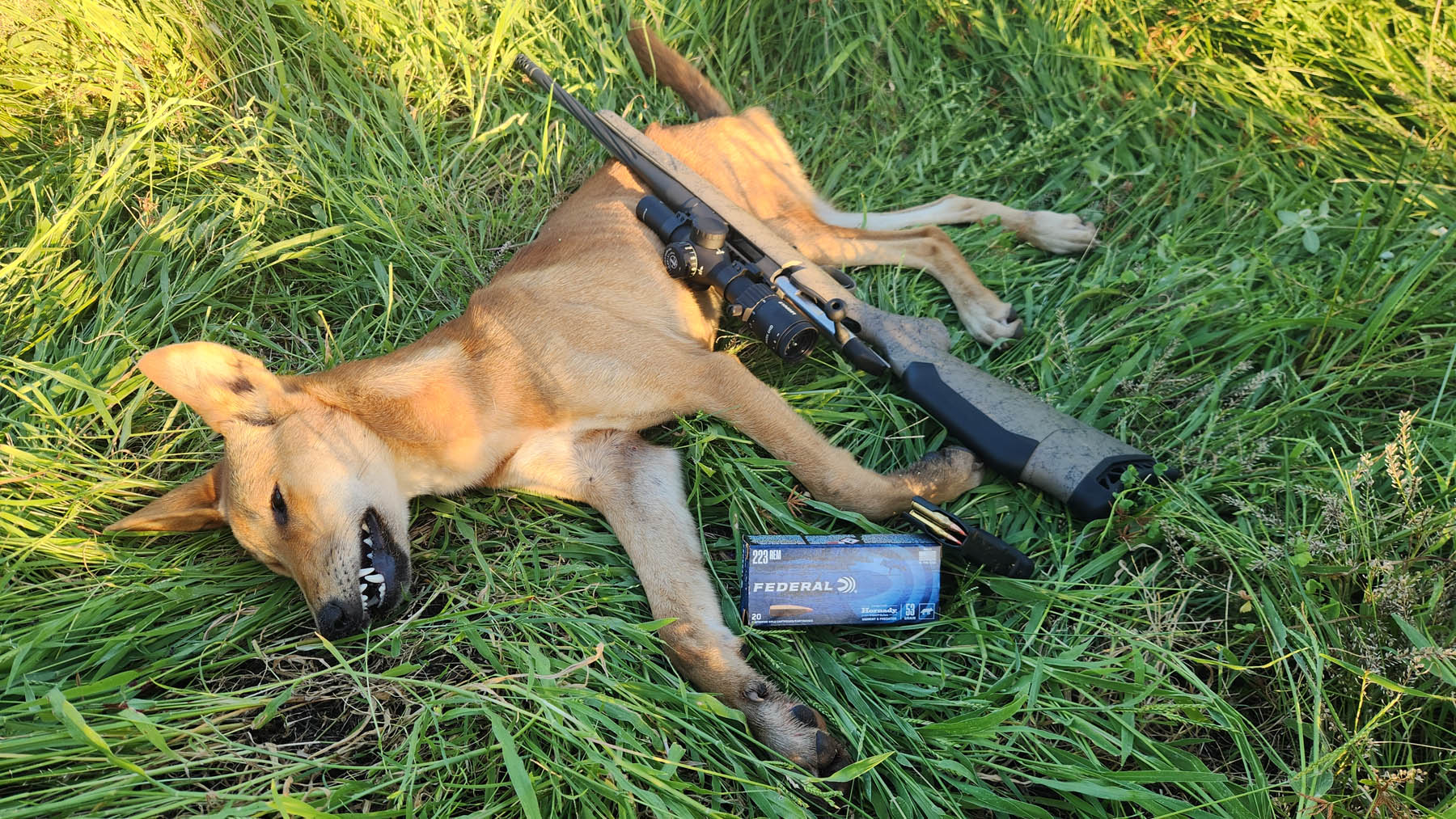
I gave a “hoy” at which she raised her head and, with the reticle now on her chest, I fired and she was down for keeps. Not a move, not a sound and my first field test was complete. Or so I thought. Daylight was disappearing fast and on heading for home I spotted a mob of wild pigs. My wife had told me to be back early for her cousin’s surprise birthday but I resigned myself to not making it on time.
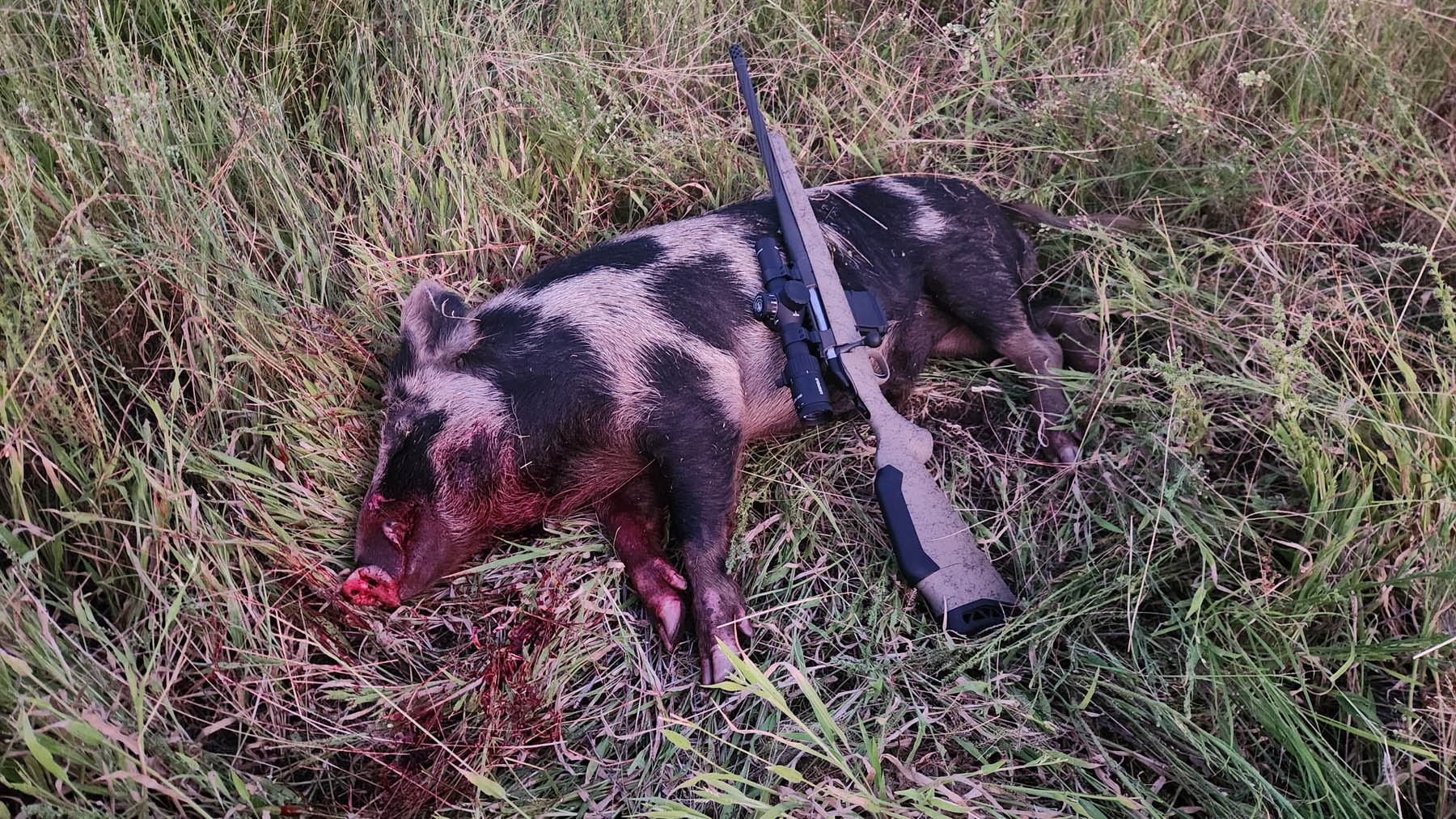
Like the dog stalk earlier, I closed in on the mob using a favourable breeze and some bushes for cover. Not wasting any time, I shot the biggest sow first. Unbelievably, the boar who was next in my sights ran towards me and not with the fleeing mob, a first for me in all my years of hunting. I stood my ground and hit him between the eyes at around 10m before his ‘cutlery’ made mincemeat of my lower legs. I jumped to one side as he flew past and piled up in heap from the first bullet.
My memory is hazy as I literally had seconds to react but, at some point, I’d rechambered another round which was just as well, as he sprang to his feet and bolted towards me from behind. Since knee surgery last year I was surprised I could still muster a sprint but this was a desperate situation as, sensing a safe gap, I swivelled and put him down for good. And with my eye well and truly ‘in’, another three smaller pigs quickly fell to the .223 Rem shooting offhand.
And finally
There’s something quite liberating about ejecting spent cartridges without having to pick up brass and that’s exactly how I felt with the Federal ammo. Saving cases for the press was the furthest thing from my mind when shooting those ferals. Shot after shot, each round from the magazine cycled faultlessly with every bullet finding its target. The bolt stop marked the end of my magazine capacity and it was at that point I wished I’d reloaded to full capacity before the stalk.
I had a dream run with this rifle and my only regret is there was no-one around to film the charging boar. I couldn’t fault what Ruger have marketed as a cheaper alternative. Prices may vary but for those looking for a budget rifle retailing for around $1200-$1300 (at time of writing), the Gen 2 Scout is by no means budget-build quality and worthy of serious consideration. For a full list of chamberings and more, visit www.nioa.com.au.