

Ivo Dimitrov charts an iconic Beretta pistol
The Beretta Model 1934 is a compact, self-loading pistol which was issued as the service sidearm of the Royal Italian Army in 1934 and, as the standard issue in World War Two, was given to officers, NCOs and machinegun crews. It’s chambered for the 9mm Corto or 9mm Short, more commonly known as the .380 ACP.
Fabbrica d’armi Pietro Beretta of Gardone Val Trompia has a history of firearms manufacturing dating back to 1526, when it was established as a barrel maker, making it the oldest surviving gun manufacturing company in the world. The Beretta Model 34 was basically the final iteration of a design by Tullio Marengoni, which began with the Model 1915 during World War One. That pistol was updated in the early 1920s and again in 1931.
The Model 1931 was converted to .380 ACP (9mm Short) as the Model 1932, which became the Model 1934 with the addition of a hammer half-cock notch and steel grip panel backing. Police and military contracts began in 1935, with the Italian Army formally adopting it a year later and buying almost 400,000 by 1940. It would ultimately see service with basically all the armed elements of the Italian military and civil security services, as well as foreign nations including Germany, Romania and Finland.
As a souvenir for Commonwealth or US troops, the Model 1934 was also a prized piece. It’s compact, simple, durable and reliable and is an excellent military pistol, easy to carry unobtrusively yet dependable when called upon. After WWII it stayed in production until the late 1980s, despite the introduction of many other more modern options by Beretta.
When the Italian military was looking for a new sidearm in the early 1930s, they really liked the pistol submitted by Beretta but were also keen on the Walther PP. During the development process, the military requested Beretta add a Walther-style slide-mounted safety/de-cocking lever to the Model 1934. Beretta opposed this as it added complexity and, as a counter offer, proposed to include a half-cock notch as a safety feature.
Nevertheless, they began producing pistols with the Walther-style safety for an initial military trial contract of 650 guns. Once the Army commission realised the extra safety was redundant and increased the price per unit, they opted to take the gun as initially proposed by Beretta with the added half-cock safety, which delayed Army adoption by a year.
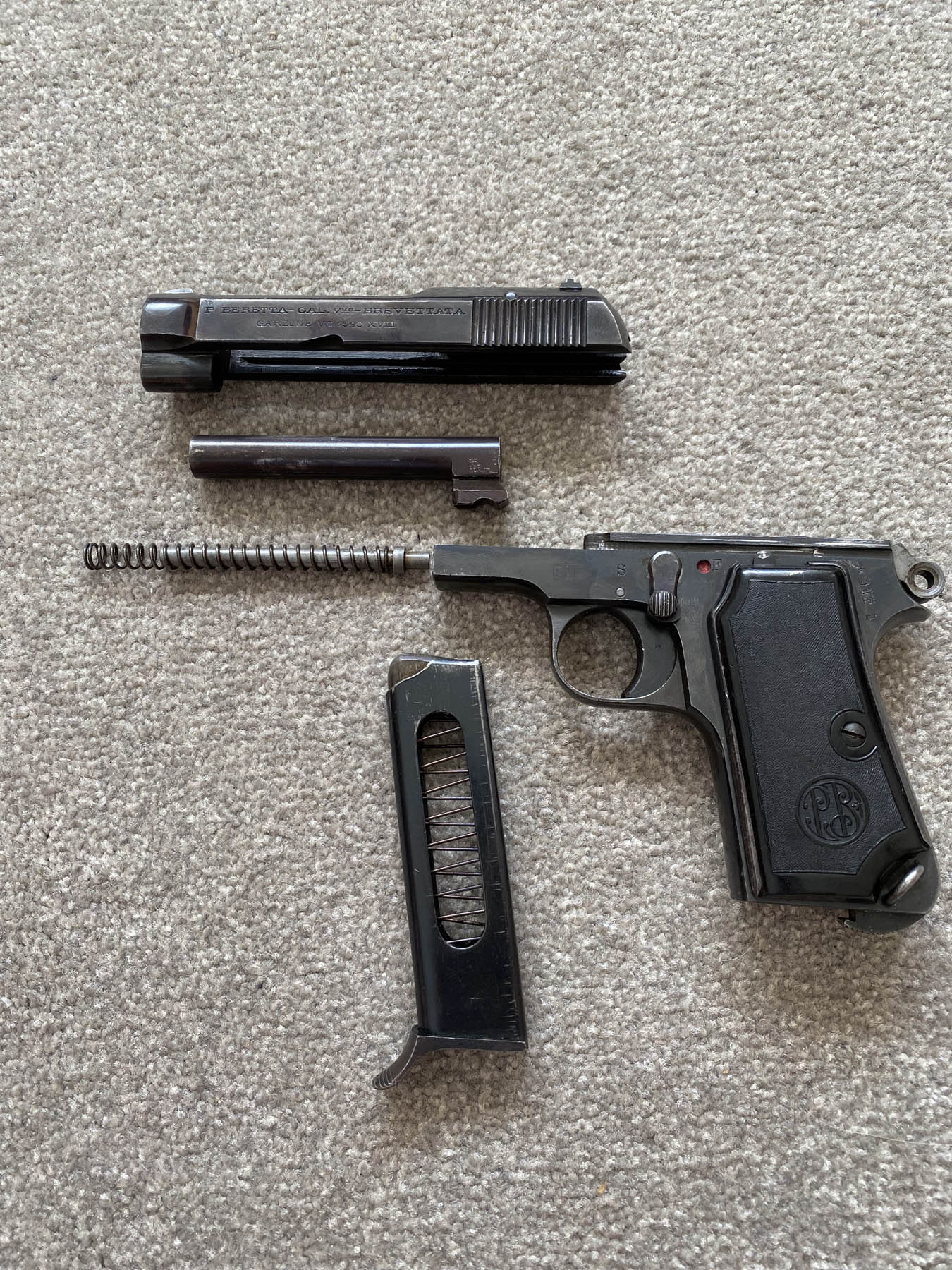
The Model 34 was followed by the Beretta M35, essentially the M34 but chambered in the .32 ACP (7.65mm Browning) cartridge. Fitted with the characteristic Beretta open-top slide which would be later used on the more famous Model 92, the M34 is a highly reliable simple blowback pistol. It has a seven-round box magazine and is made with relatively few parts and is straightforward to maintain. For all practical purposes Beretta was the sole maker of these pistols, with the only known other manufacturer being Armaguerra, which apparently produced no more than 400 for the German military in 1944.
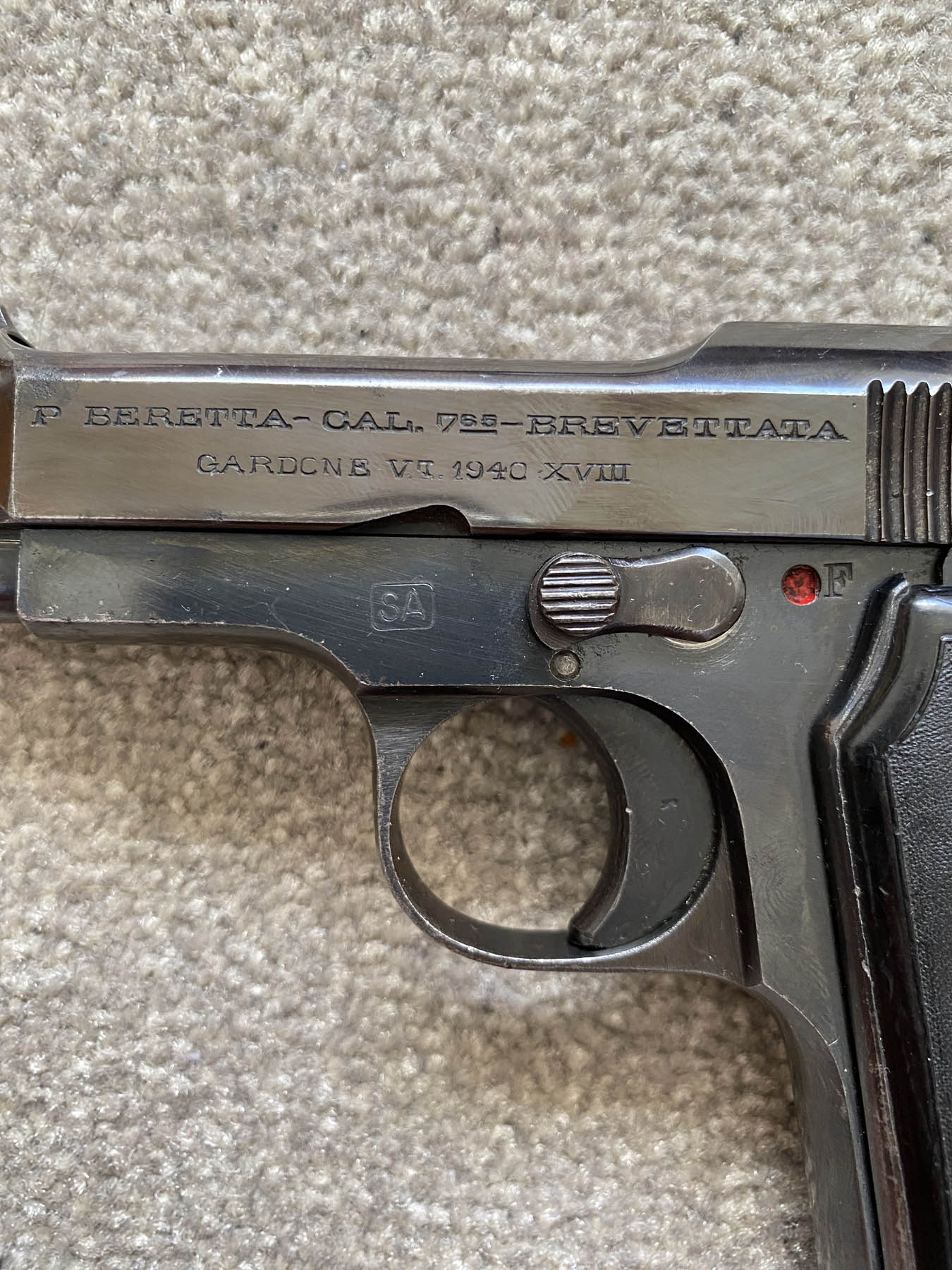
Pistols made during the fascist-era are marked with their year of manufacture in two forms: the conventional Julian date in Arabic numerals and date in the fascist-era in Roman numerals. The fascist calendar started on October 28, 1922 (Benito Mussolini’s rise to power), so a pistol from 1937 may carry either ‘XV’ or ‘XVI’ as its fascist year.
Pistols accepted by the Italian armed forces usually exhibit acceptance marks stamped into the frame on the left, just above the grip: ‘RE’ (Regio Esercito) for the Army, ‘RM’ (Regia Marina) for the Navy or ‘RA’ (Regia Aeronautica) for the Air Force, in the form of an Eagle wearing a Royal Crown for the Royal Air Force. Police pistols may be marked ‘PS’ (Pubblica Sicurezza).
The Romanian military, at the time an Axis power, also bought M34 (and M35) pistols. The calibre marking appears as 9mm Scurt (‘Short’ in Romanian) rather than 9mm Corto. Romanian Army M34s differ from the Italian version in that the former use the Russian sight picture, while the latter have the standard sight picture used by Western armies.
Following Italy’s surrender to the Allies in 1943, German forces seized control of Italian arms factories, including Beretta and Armaguerra, the producing Beretta M35s under German control, with only about 400 made. M34s were also made during this period (1943-45) for German and Italian Socialist Republic use and these, also produced under German control, can be recognised by the ‘4UT’ inspection mark.
An M34 with serial number 606824 was used by Nathuram Godse in the 1948 assassination of Mahatma Gandhi. The pistol, made in 1937, was carried by an officer during the Italian invasion of Abyssinia and subsequently taken by a British officer as a war trophy. It’s unclear how it came to India, but Godse was given the unlicensed firearm by a co-conspirator. From 1934 to 1992, about 1080,000 units were produced.
M34 and M35 in Finnish service
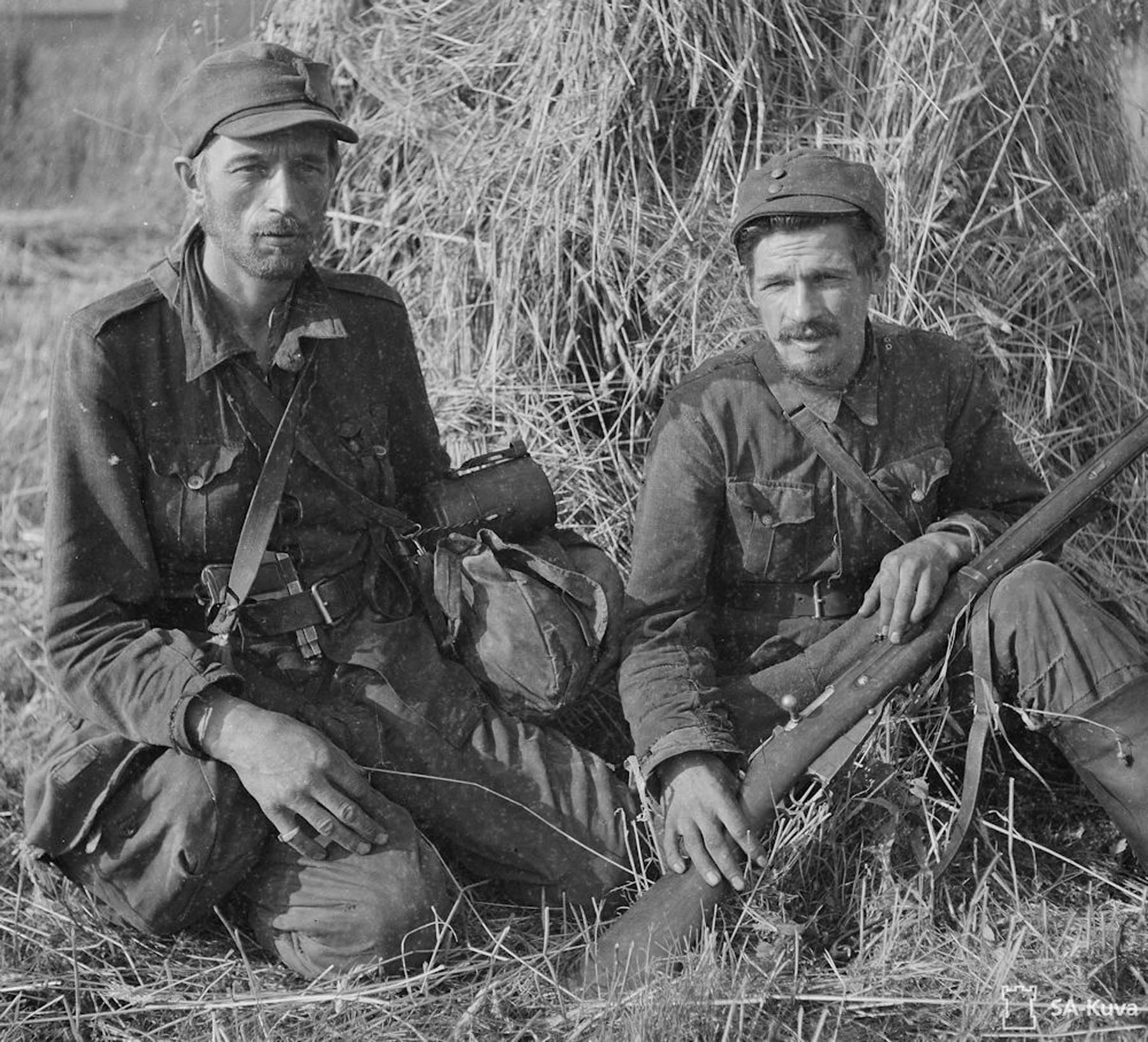
At the outbreak of the Winter War in November 1939, Finland was desperate for all the small arms it could muster, buying M38 Carcano rifles from Italy as well as Beretta M34s and M35s. During the Winter War only 60 M34s arrived in Finland among miscellaneous materials. The Finnish Civil Guard (Suojeluskunta) ordered 500 M34s from Italy in July of 1941, though the deal was plagued with problems and pistols weren’t delivered until April, 1943, the Civil Guard issuing them to home and front troops almost immediately.
The Finnish Army on the other hand ordered 4000 Beretta M35s in April of 1941 and while the Italians had problems delivering enough, they had sufficient M34s to replace them. The Finns eventually agreed to accept around 900 M34s as their replacements. Considering this, the total number of M34 pistols in use by Finnish armed forces was probably around 1400-1500.
The Finnish Civil Guard was disbanded in 1944 as part of the Armistice with the Soviets, thus their pistols ended up in Finnish Army inventory. In 1951 that inventory included 999 M34s which remained in storage until 1986.
The Finnish Army made two orders of M35 pistols to Italy during WWII, both in 1941, the first containing 1000 pistols which arrived in late 1941. The second order of 4000 proved problematic and only 3092 were delivered by late 1942, the Italians replacing the balance with 900 M34s instead. During the Continuation War, both Finnish frontline and homefront troops used Beretta M34/M35 pistols. In 1951 some 2091 M35s remained in Finnish Army inventory until eventually, in 1986, most of those were sold to the commercial market.
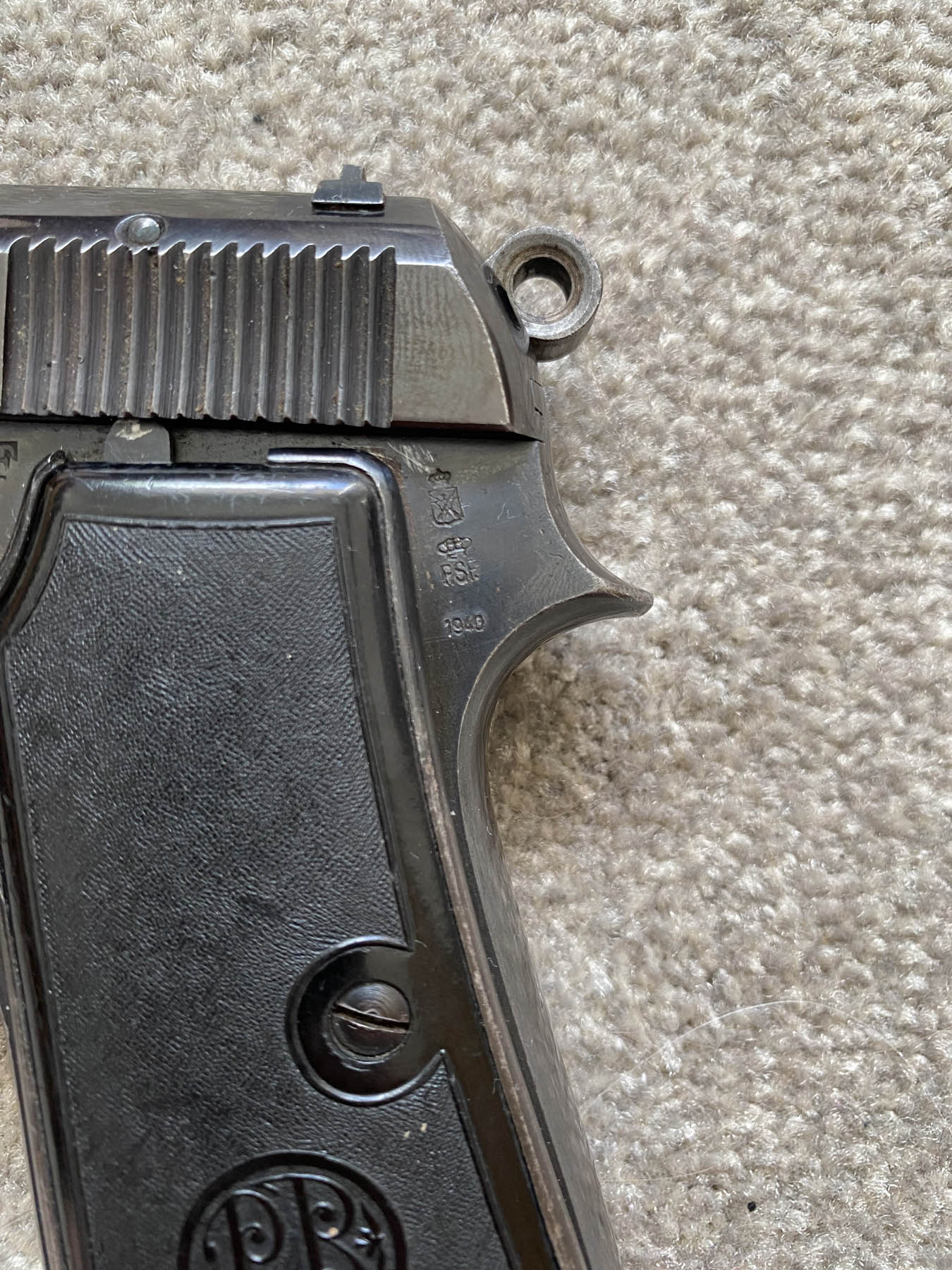
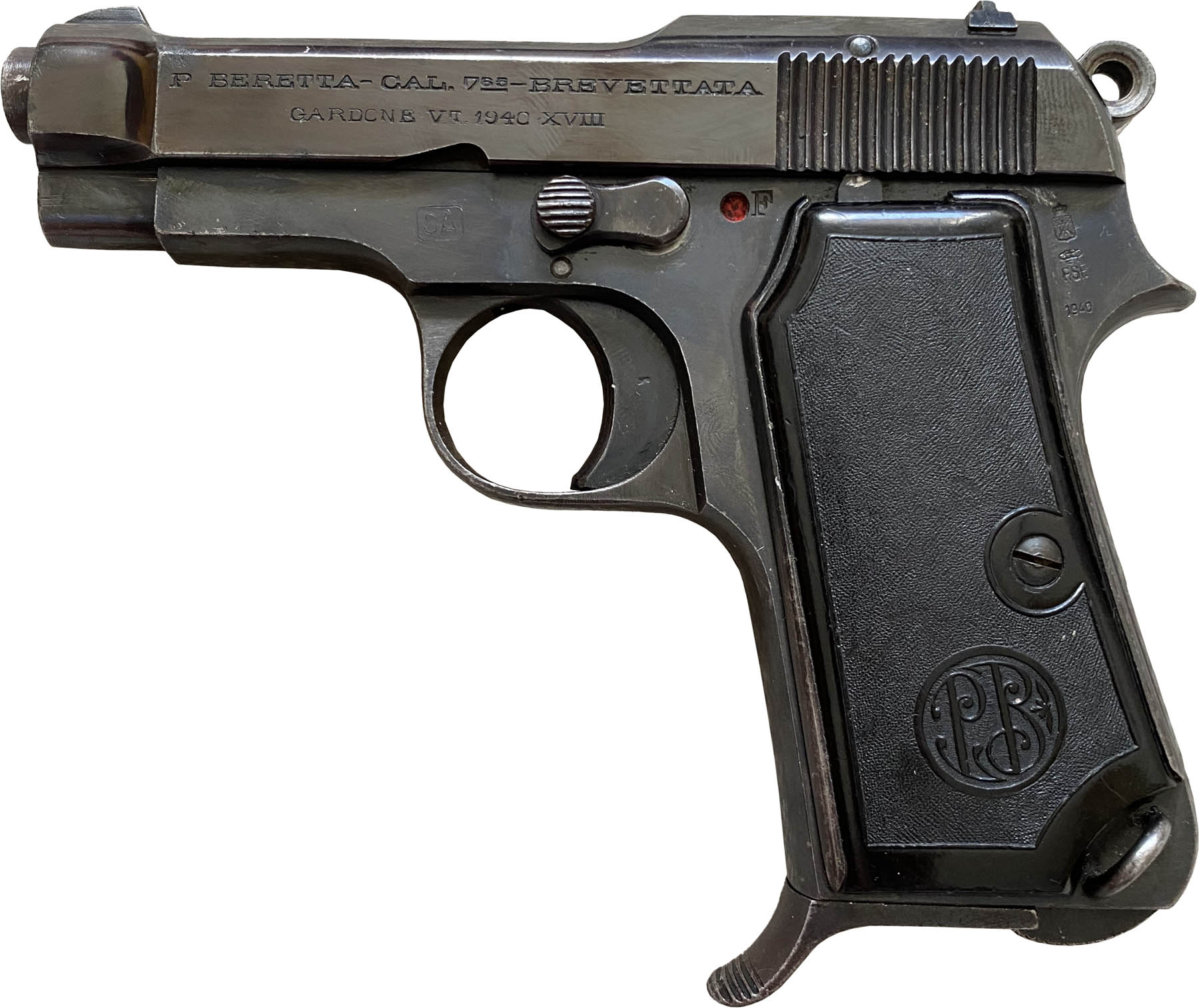
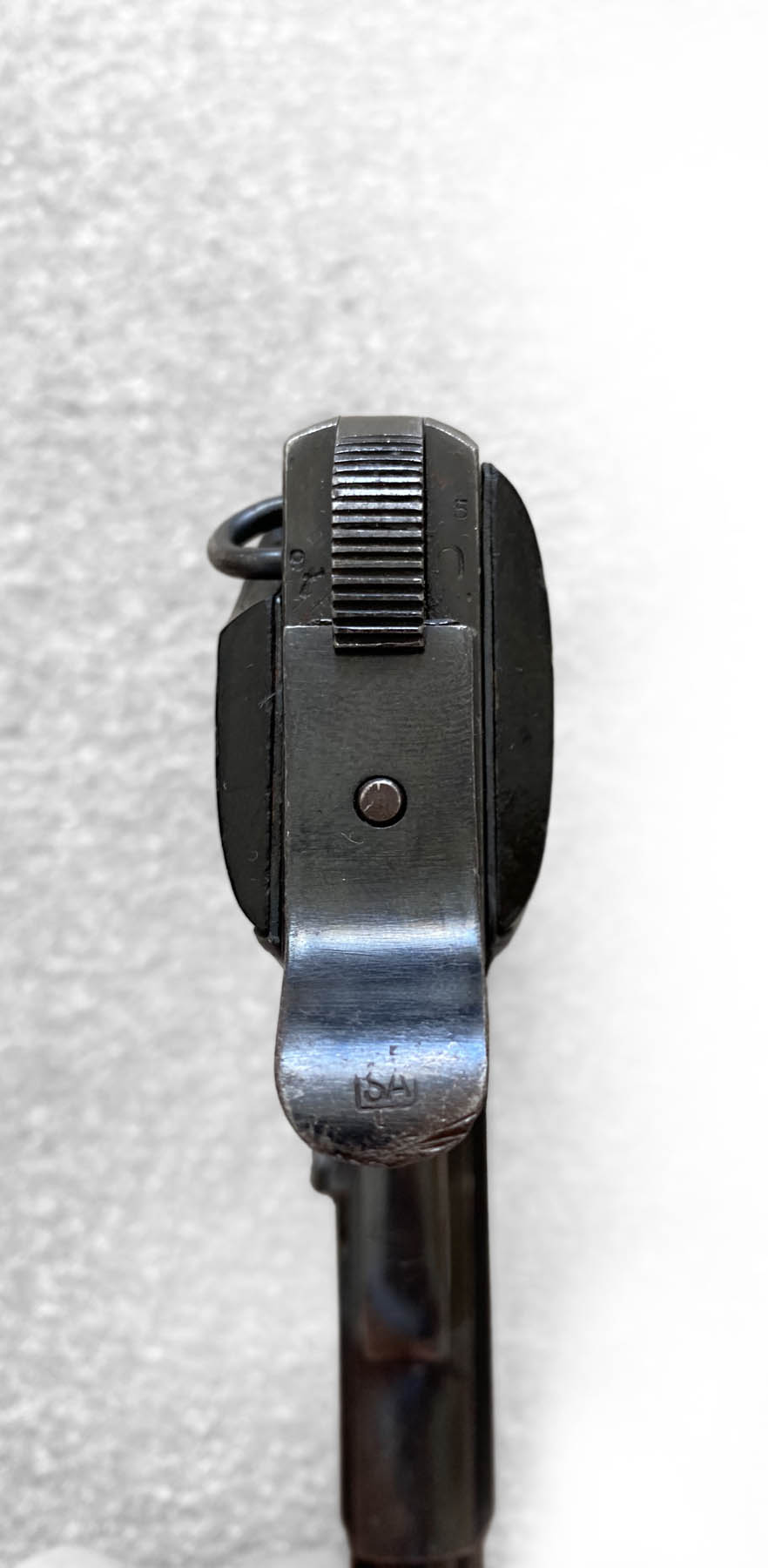
The example featured here is an early-contract M35 made in 1940 and year-dated XVIII according to the fascist calendar, meaning it was produced pre-October 1940. It has commercial Beretta proof marks on the frame and is SA (Suomen Armeija) Finnish Army property marked on both frame and magazine.