


From farmland to bushland, feral pigs are wreaking havoc – Dick Eussen breaks down the problem and how we can fight back
Habits
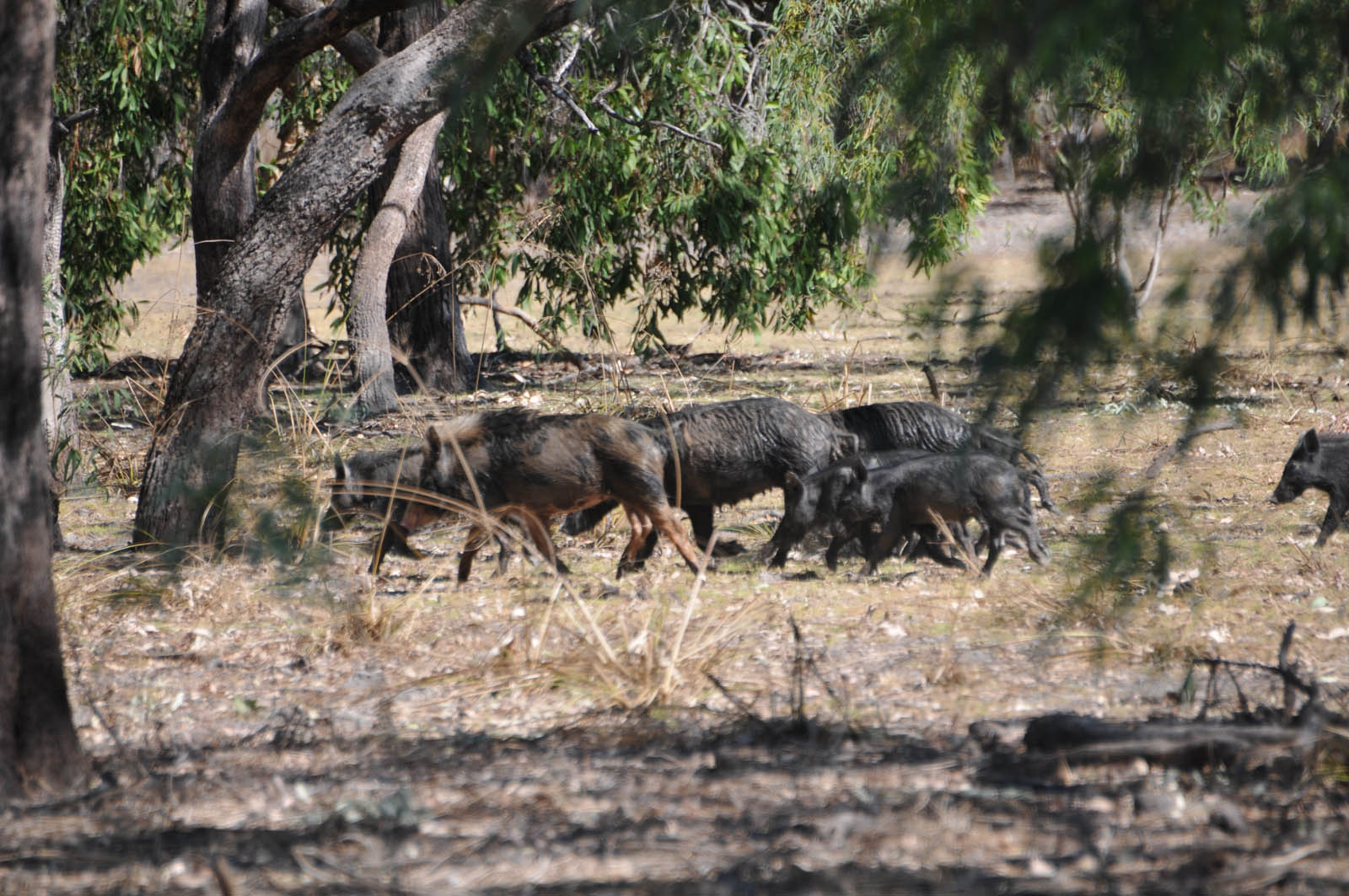
Feral pigs are arguably our most popular game species, being readily available across this wide land where they have proliferated in huge numbers. They flourish in all sorts of country, including desert and snow. Because of their prolific breeding cycle, pigs regenerate quickly when populations dwindle and are subjected to drought and control programmes such as live trapping, shooting and poisoning. It only takes a good season to boost their numbers, thus control is never ending.
Feral pigs have mathematics on their side as a sow has a gestation period of 112-114 days, which means she can drop 2-3 litters per annum. A sow commences breeding when she is 6-8 months of age at a weight of about 30kg. While the average litter is six, some sows may drop up to 10 piglets when conditions are good. Boars are sexually active at 10 months of age. Pigs have a short lifespan in the wild, rarely making it beyond six years of age.
Just before birthing, a sow makes a nest from the nearest available materials. Some are nothing but a sandy hollow under a creek bank. Although elaborate nests made from fresh palm leaves can be spotted in the Daintree Rainforest. These resemble European boar nests, with some 4m in diameter and 80cm high. Sows hide the piglets in the nest for a few days before they follow her into the bush. When danger threatens, the piglets find any cover available or simply freeze if caught in the open. Most sows will leave the brood and return later when the threat is over. The odd one will attack the danger.
The Daintree Rainforest piglets have the same camouflaged stripes as their European boar counterparts. Evolution may have reversed, and they are reverting to their original status, or perhaps rainforest feral pigs are becoming a breed of their own. It’s rare to see similar colourations on the tropical savannah plains and woodlands.
Impact
Feral pigs have a wide impact on our farming industry and are a huge environmental pest in wilderness regions. This is especially so in national parks and fauna sanctuaries, with lack of funding or simply lack of will from authorities to control them. Pigs eat anything they come across. They trample and root swamplands in search of plant roots and invertebrates, competing directly with native fauna for food, water and shelter, while preying on them and eating their eggs and food. Pigs eat earthworms, insects, crustaceans, reptiles, ground nesting birds and their eggs, mammals, crayfish, molluscs, frogs, turtles and farm animals – fowl, lambs and calves, grasses, fruits and grains.
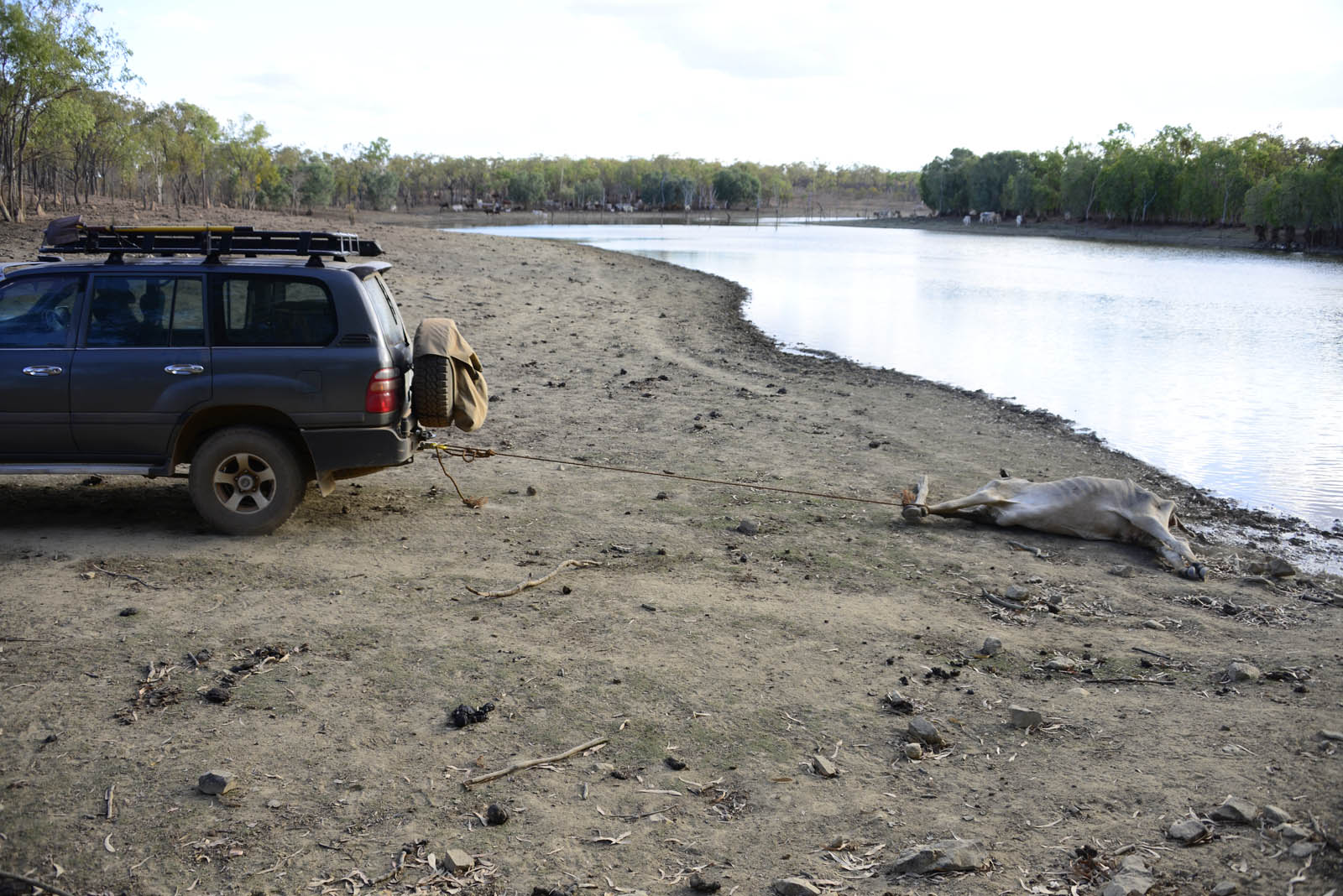
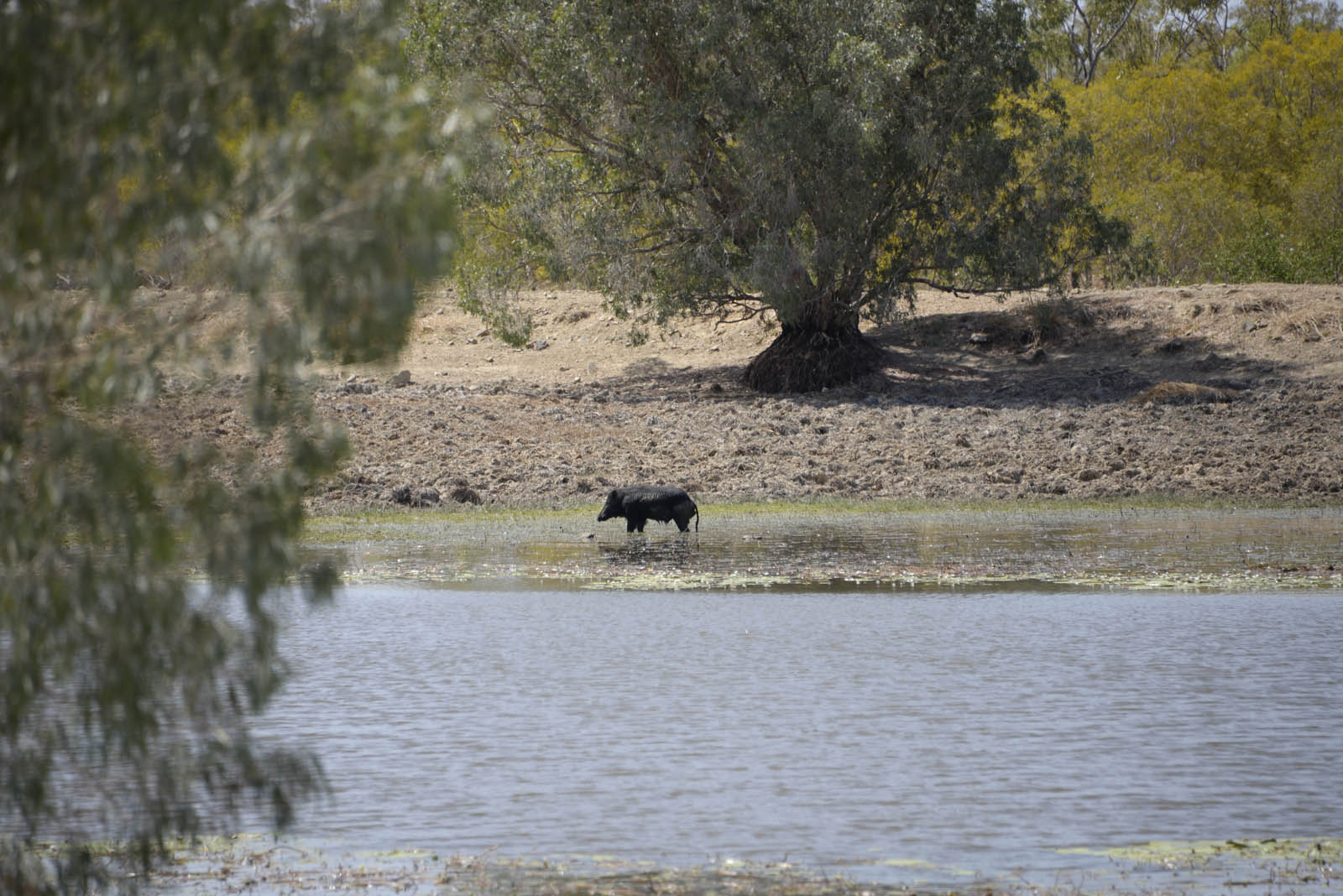
During dry periods they wallow in wetlands and on the edge of man-made dams. This creates deep hollows that trap and bog cattle and sheep when they water. They die and are eaten by pigs, some when still alive. During calving and lambing seasons, they hang about birthing ewes and cows and eat the afterbirth and sometimes the newborn, a trait they share with wild dogs.
Their foraging and wallowing effect is damaging to wetlands where they destroy riparian vegetation that is food and shelter for natives. No wetlands remain in the tropics that have avoided damage by feral pigs, while the same applies to other regions across Australia.
Apart from wild dogs, pigs have few natural predators. Many piglets are taking by wedgetail and sea eagles, while in the tropics their worst nightmare is the estuarine or saltwater crocodiles. Some will take the largest boars. Pythons also eat them, but they take a risk by being attacked and eaten if other pigs are about.
Humans also prey on feral pigs and it’s a valuable addition to Indigenous people in the tropics, while many hunters take the meat from young pigs home to eat. However, a word of warning. Feral pigs tend to carry diseases and are known carriers of that could affect humans, cattle, sheep and wildlife. It includes leptospirosis, brucellosis, melioidosis, Japanese encephalitis and swine fevers. If foot and mouth disease is ever introduced in this country, keeping it in check would be impossible due to the feral pig problem.
Size matters
Feral pigs are much leaner and muscular than their domestic counterparts, and fitter. Due to the need to root about often hard ground for food, they have developed wider shoulders and necks, smaller hind quarters, heavy muscular shoulder pads and coarse hair. While black is the most common colour, variations occur ranging from rusty red, ginger, brindle, black and white, white or a mix of all. As mentioned, tropical rainforest piglets are marked with dark longitudinal stripes that vanish as they grow older.
Feral pigs have long snouts, tusks, straight tails with a bushy tip and small eyes – said to be the cause of poor eyesight, though in reality they have excellent eyesight matched with a superb sense of smell and amazing hearing. The boars tend to become solitary at about 18 months of age and they only join a mob when sows are in season. Most are chased from a mob by the alpha boar.
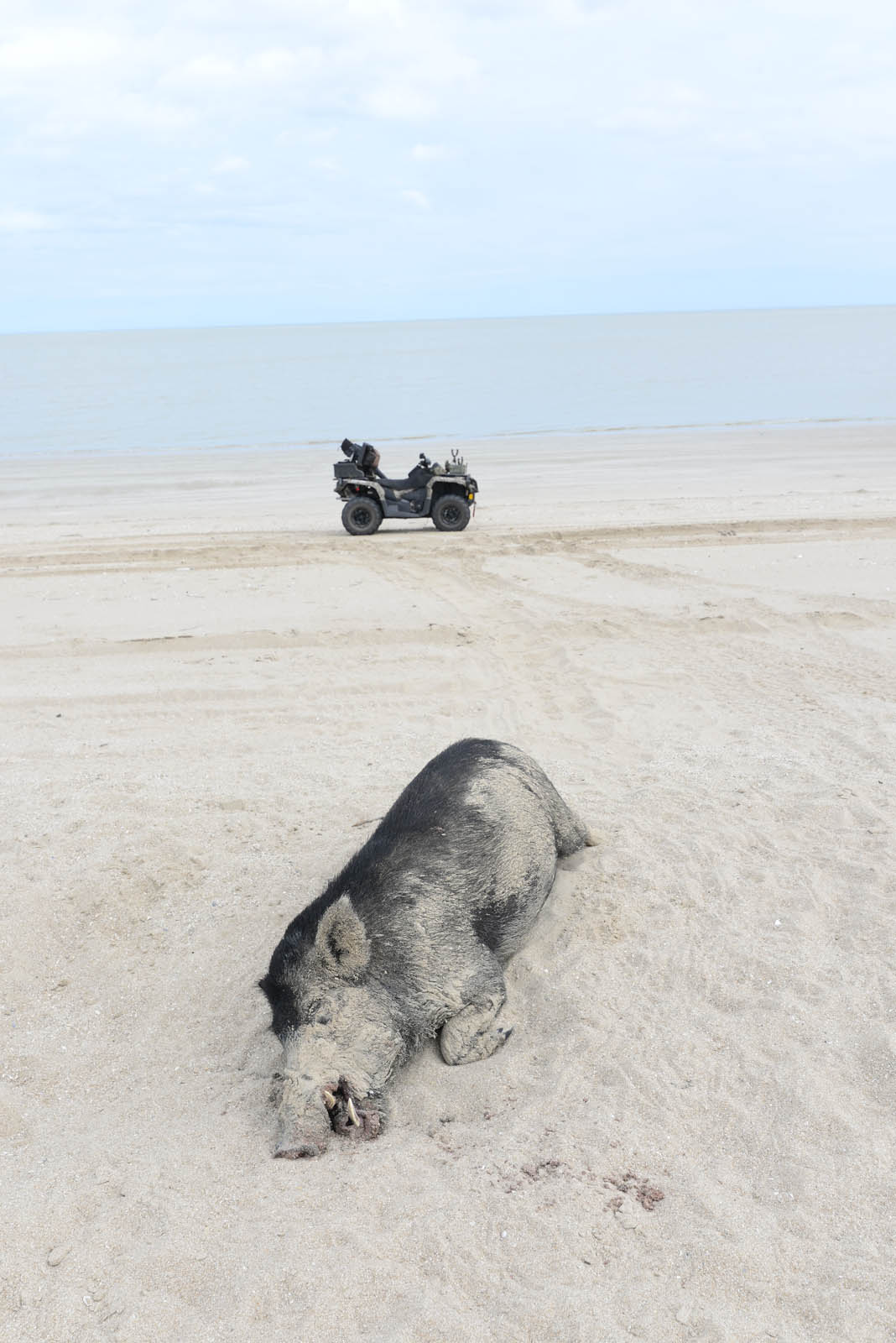
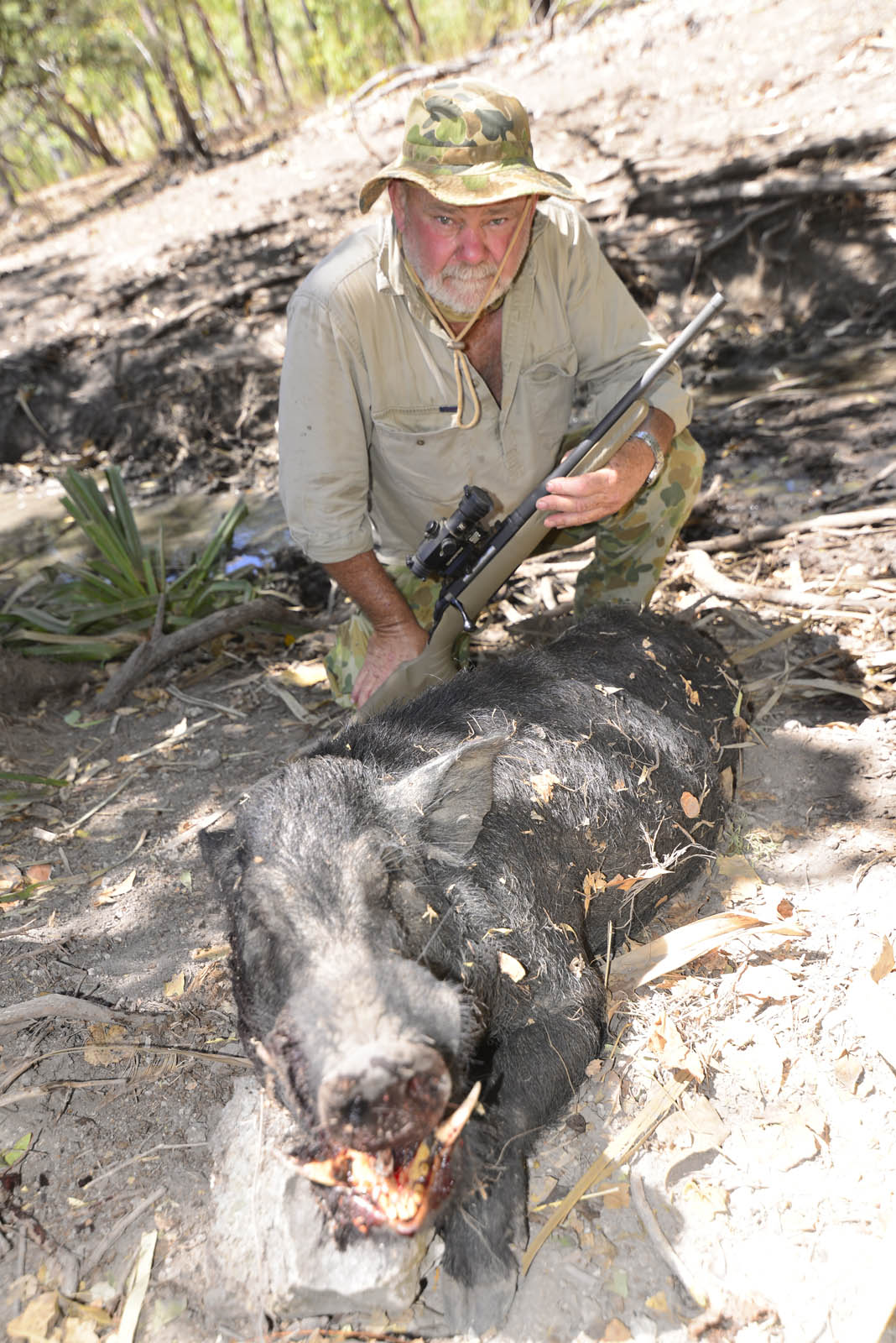
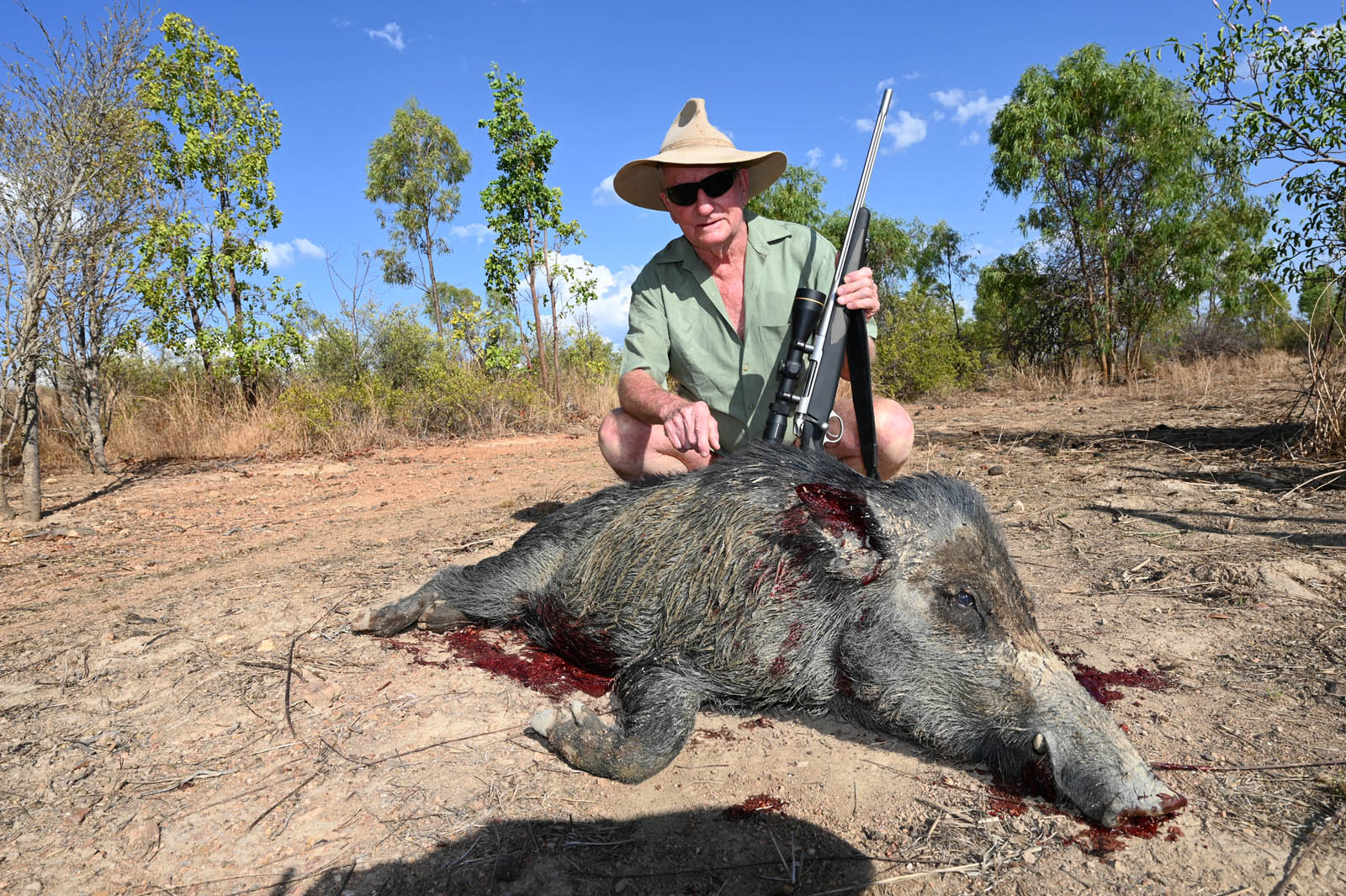
There is a huge variation in weight; males are heavier, longer and taller than females and outweigh them at comparable ages. The average weight of females is 50-60kg, but the males’ range in at 80-100kg. These weights vary, for instance pigs that feed on grain fields can double that weight. Tropical pigs are also heavier and those that feed on turtle eggs and fish offal average 120kg. Pigs have been shot that weighed over 250kg!
Management
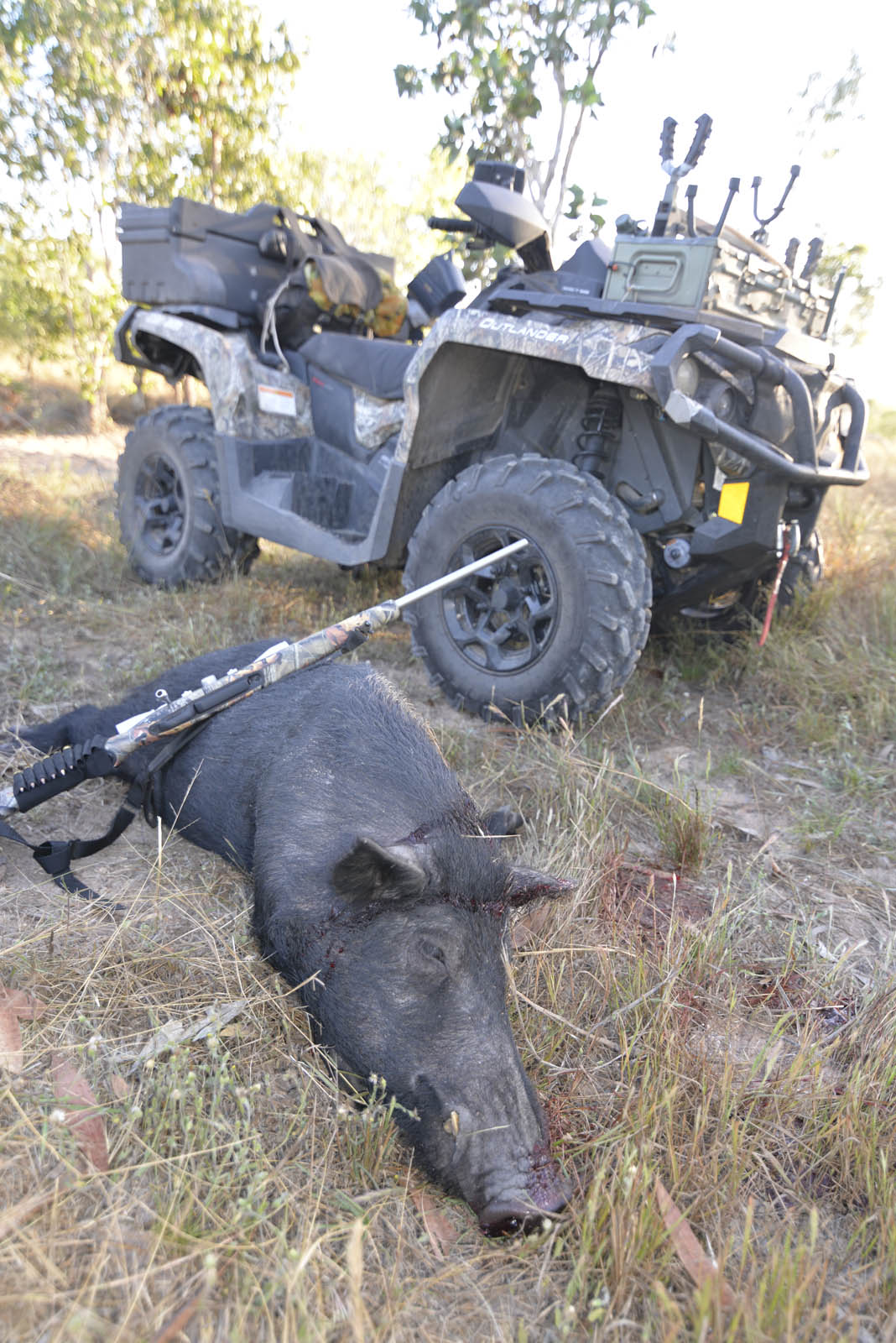
No matter what control measures are taken, wild pigs are here to stay and for the hunter they offer great sport, providing permission to hunt on a farmer’s land is provided. They can be hunted year-round without bag limits in place or the need to remove carcasses. Not that they last long as pigs are cannibals, who along with crows, kite hawks, eagles, goannas, crocodiles and wild dogs, eat the carcasses in a day or two.
Thus, there are many opportunities for hunters to shoot feral hogs. They can do land managers and farmers a favour at no cost to them. Unfortunately, this is largely ignored by both camps and by the National Feral Pig Action Plan that promotes poisoning, trapping and helicopter shooting for control. They have continuously failed to recognise the contribution that pig hunters can make to help manage the problem.
I was a member of a Landcare group for several years and organised feral pig workshops in rural towns and on farms where ways to combat the menace were discussed. In many cases government officials and some farmers were openly hostile to having hunters eliminating feral pigs. However, both camps were in favour of taxpayer assisted funding to eradicate feral animals. It seems government officials are biased towards helicopter shooting controls and wasting tax money.
Farmers opened up to the idea of hunting when I provided evidence that shooting controls pigs to the point where calving numbers increase and large mobs no longer roam stations. Most farmers are worried about accidents and bio-controls along with the insurance costs associated with allowing visitors on their properties. When made aware that SSAA members carry personal public liability cover they became more open to discussion. It’s a great membership inclusion. Farmer Assist is another attraction for farmers and members to safely and successfully manage feral pig numbers.
Hunting
The reputation pigs have of poor eyesight and being hard of hearing is poppycock. In fact, they have excellent vision provided they have the open space to see across. Up in the tropics the country goes in drought-mode at the end of the dry season and little grass cover remains until the first thunderstorms roam the land and magically turns it green overnight.
When the land is bare, pigs can see a long way, even from their low position close to the ground, unlike when grasses are tall. They lay up during the heat of the day on ridges to catch cooling breezes where they enjoy panoramic views to far horizons. When they are hunted hard, they will move off at the first sign of a vehicle or a hunter and vanish into scrub or over a ridge in minutes, even though the vehicle may be kilometres away.
In areas that are seldom or never hunted, a good hunter can walk on top of them and catch them asleep on the job. In many cases they are aware of the hunter and tend to rely on not being seen. I have had my hunting mate walk 50m in front of me on scrub-covered dam walls and seen pigs suddenly appear out of cover and try and sneak away 10m behind him. They must lose their nerves on being caught out while napping. The odd one comes out at a full charge, the reason that the hunter must always be on full alert when hunting in thick scrub and tall grasses.
Feral pigs are nocturnal and restrict their activities to the cooler parts of the day, in what is termed a ‘home range’. A mob, and boars kicked out by rivals, have a defined range where they forage, and drink, using connecting cattle pads, or those of their own making in national parks where no grazing is permitted.
Tracking shows an adult boar roams in a 10-50km2 patch, the size depending on the availability of shelter, food and water. Sows have a smaller patch of about 10-20 km2. Lactating sows have an even more restricted area, but it widens again as piglets grow older. If a food and water resource are abundant, they may not move any more than several hundred metres from it until its depleted, or when disturbed by hunters.
One thing that favours the hunter, especially in dry country and drought conditions, is that feral pigs must have access to water and cooling wallowing sites twice a day, depending on the temperature. Experienced hunters know that and use it to their advantage. When hunting in promising areas, look for wallows about water and dust patches for fresh tracks, tree rubs and droppings.
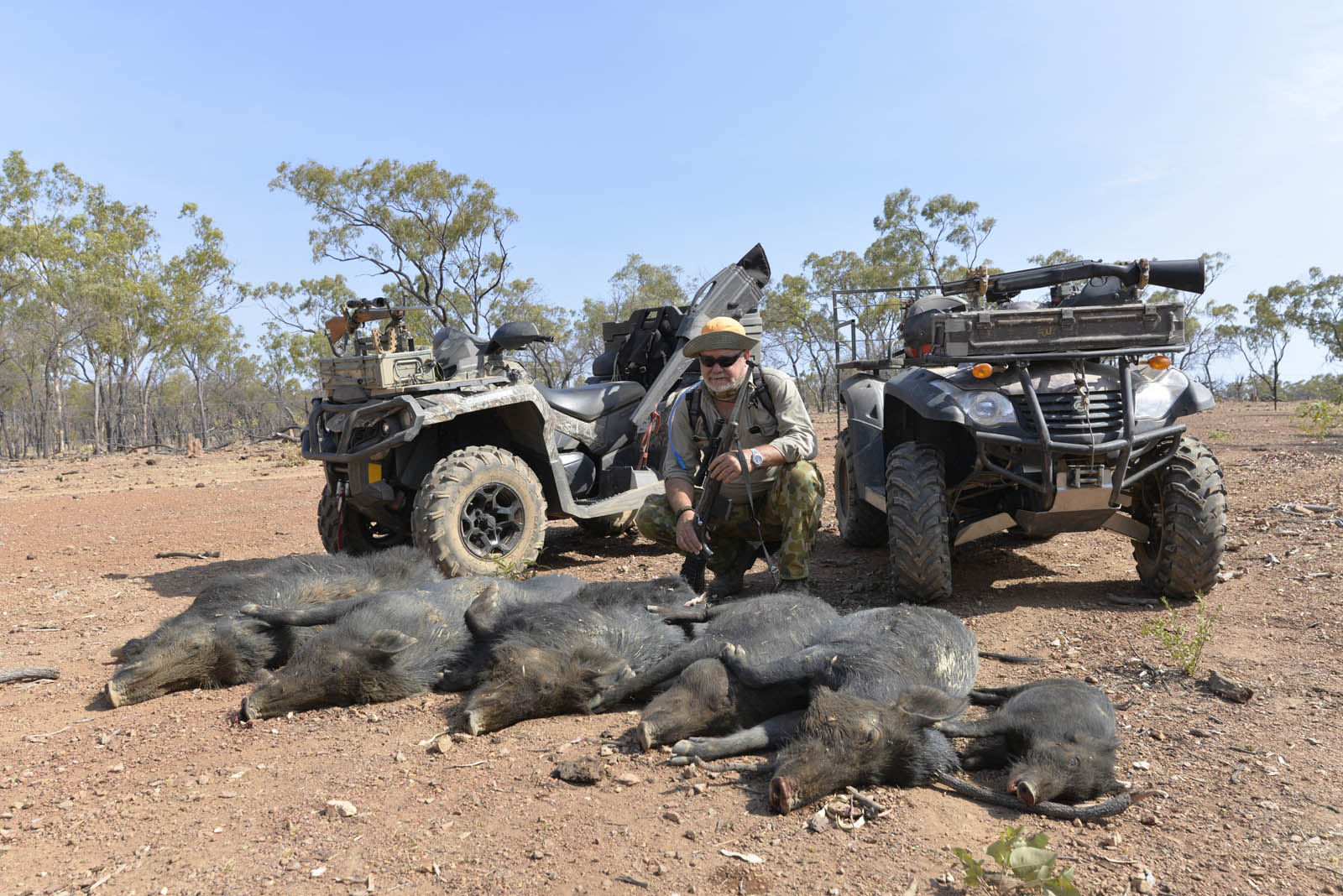
In many areas, mobs of up to 50 or more are present. I have seen one mob that held over 900 – that was the number shot by a helicopter shoot over one day. The mob were all ‘pets’ to a commercial barramundi fisherman on the Holroyd River on the west coast of the Cape York Peninsula. He fed the pigs on fish frames and offal on an almost daily basis. From reports he was enraged when the Pormpuraaw Indigenous Land and Sea Rangers shot the pigs to protect turtle nesting sites. The animals had little chance as the only cover is a narrow mangrove strip along the river that is highlighted by an open tidal flat and grassy plains. It was one time that heli-shooting paid off, as it would have taken many hunters to eliminate the pests. For the record the rangers used FN rifles in .308W calibre. They have some top marksmen in the team.
The right cartridge
I have shot pigs with a .22 rimfire and a .600 Nitro Express, and many calibres in between. While small pigs and most sows are easy to kill, big bristling well-padded boars are something else and an adequate calibre is a must. There are many suitable calibres to choose from, including handgun calibres. I shot big boars with handguns ranging from the 9mm Luger, .38/357M, .44 Magnum, .45 Colt and the .45/70 when I lived in the NT during the whole of the 1980s. I could legally do so at the time.
There is no doubt that the .30-30W and the .308W rate highly as preferred rifle calibres, but having shot pigs with .222R. 223RM, .22-250 and the other high-speed .224 calibres, they are not to be ignored, nor is the .243 and the 6.5mm calibres.
There is a good choice of .25 calibres, 7mm and the venerable .270W, a calibre that takes some beating and will outperform the above mentioned. Most of the .30 calibres are excellent and ideal for large boars. I doubt if you will need anything bigger, but then again hunting with a .45-70 is fun, especially in a short handy Marlin lever action carbine.
No matter what calibre you use, if the bullet does not perform or is unsuited for the job it will wound. Some hunters have little idea what the differences between varmint, hunting or purpose target bullets are. I have found that European bullets tend to be harder than their US counterparts in the .224 and 6mm rounds, probably because they use rifles for multiple tasks for European boars and deer, which require a bullet that can handle all.
I have a few boxes of Norma .223 Magnum bullets that are loaded with 55gr projectiles. They kill pigs as well as a .243W loaded with 100gr Speer bullets. But US-made varmint-type bullets in .224 don’t perform anywhere as well on big hogs. When you step up to a larger calibre, the .270W for instance, you can load them with light 90, 100 or 110gr bullets. They kill boars with impunity, due to hydro shock, though my preference has always been the 130gr Speer or Nosler Partition bullets in my .270s and the .270 Weatherby Magnum.
Calibre and bullet selection are a never-ending argument when hunters gather. Some are too focused towards what they own and will rebuff any criticism of their beloved round, especially in camp after a few beers. Choose wisely my friends…