
Thriving!
Chris Redlich enjoys success with a ZeroTech scope
Six years ago I was happy to accept an invitation from TSA Outdoors to review the Trace HD 3-18×50 riflescope by then new optics player ZeroTech. I was impressed by the bargain-priced scope and, after reviewing more of their product lines in recent years, was happy to accept another scope from their current range, the Thrive 3-12×44 mil-dot to see if it suited my style of hunting.
The scope
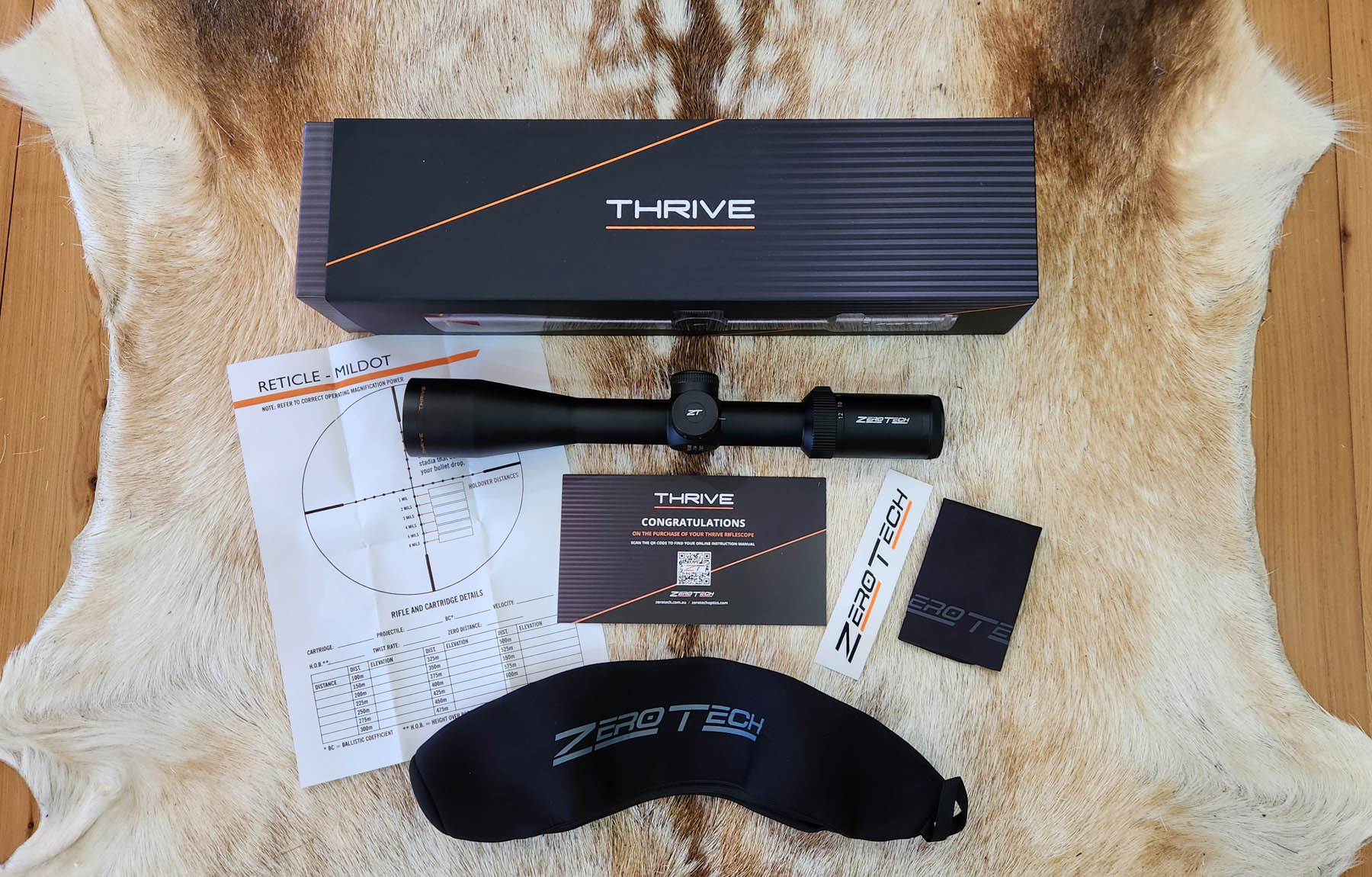
Firstly, if it’s purely a hunting experience with the Thrive mil-dot you’re after then skip to my field test section, otherwise read on for more on the tech stuff. Supplied with the scope is a neoprene protective cover, lens-cleaning cloth, ZT promotional stickers, user manual and reticle chart. In the hand the Thrive is by no means a compact scope but, with a 30mm main tube made from aircraft-grade aluminium, I didn’t expect it to be. Measuring 345mm and weighing a mere 607g, it’s light yet looks robust enough to ride on the back of a hard-kicking hunting rifle. By all appearances though, the Thrive 3-12×44 is a well-balanced and ergonomically designed hunting scope.
The dioptre adjustment dial is a knurled alloy ring, gripped easily and rotated for a clear view and reticle image. Unlike my previously reviewed Trace HD model with a generous 90-100mm eye relief, the Thrive 3-12×44 offers a marginally shorter 85-90mm. Forward of the ocular housing is the 3-12 magnification dial with all numerical adjustments highlighted in white. The dial has well pronounced lugs which promote a firm yet easy grip for selecting your chosen magnification.
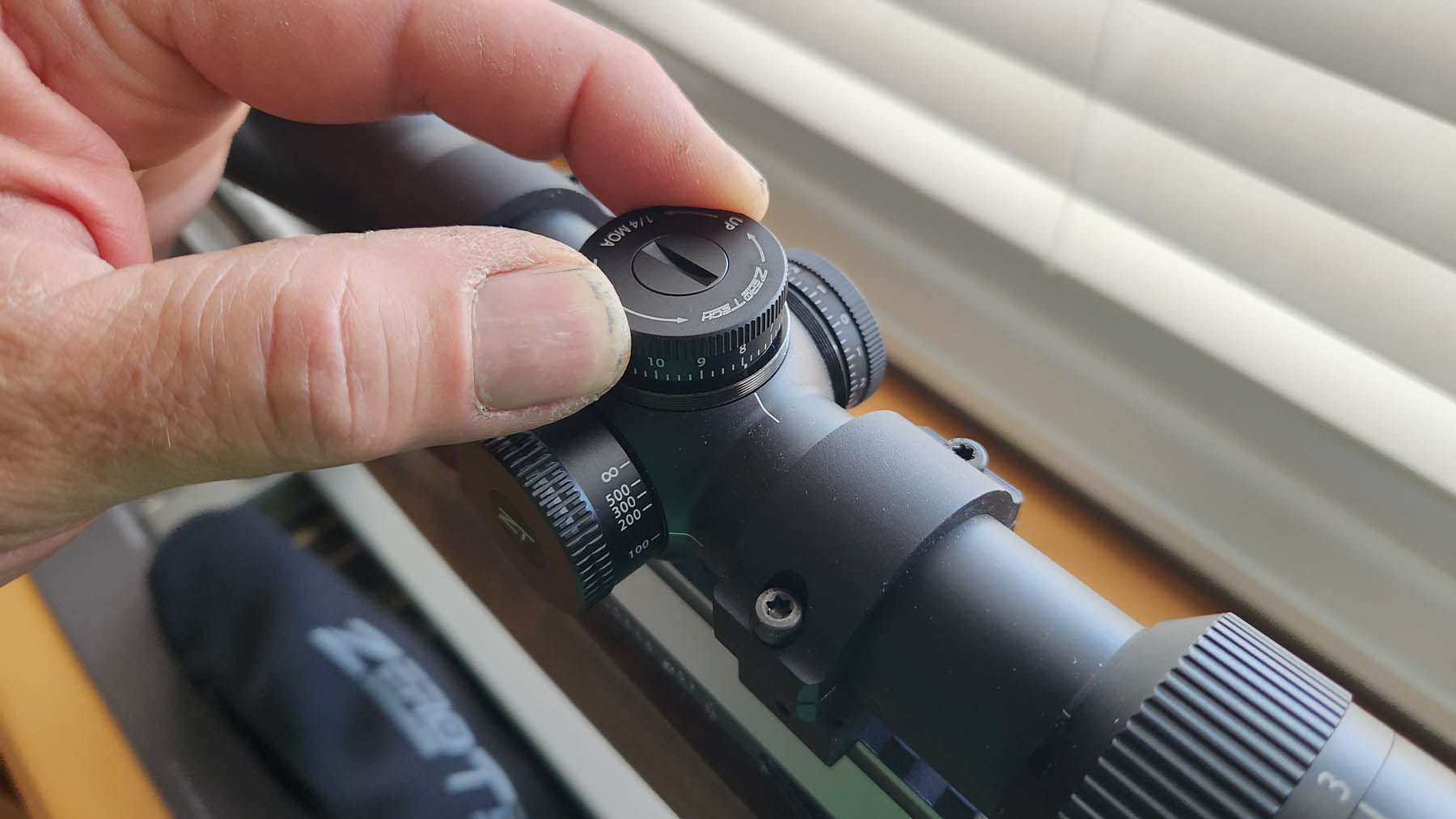
Elevation and windage turrets are clearly marked for a .25 MOA adjustment and both have a full 60 MOA of travel. It may seem odd that a scope with an MRad (mil-radian) reticle uses MOA adjustments though it’s not unusual. MOA is a standardised unit of imperial measurement that’s not only popular with Aussie hunters, it also makes perfect sense for the sake of consistency in the Thrive models.
Nine on the dial is the side focus (parallax adjustment) and can be set from 10m to infinity. The internals and components are O-ring sealed and purged with argon gas, making it completely waterproof and fogproof, while the external surface is protected by a matt black non- reflective coating. Finally, the fully multi-coated 44mm objective lens is protected by ZeroTech’s weather shield coating, to provide clear light transmission with 12.2m field of view at 100m on 3x zoom and 3m on 12x.
Mil-dot (SFP) reticle
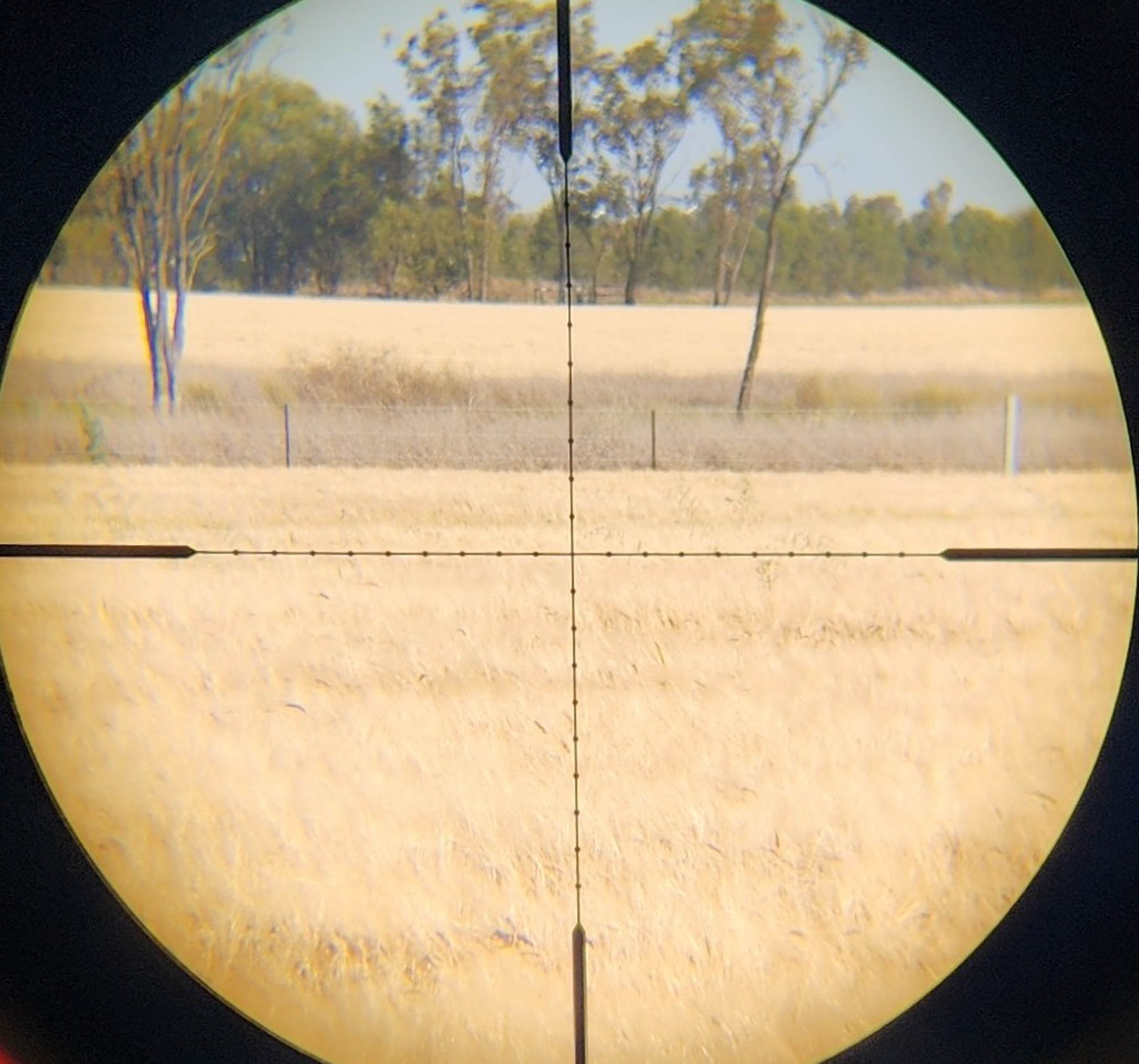
Thrive model scopes offer a variety of reticle choices including my favourite Duplex, PHR II, PHR III and the popular mil-dot for 44mm objectives only. The reticle is glass etched and located in the second focal plane (SFP) within the ocular housing (magnification end) of the scope. When a reticle sits in the second focal plane, its size won’t alter with varying magnification and for this reason I don’t recommend the Thrive mil-dot scope purely for long-range target shooting. A first focal plane scope such as the ZT Trace ADV models are better suited for that, as their reticles increase proportionately with magnification.
For those unfamiliar with mil-dot, the inner reticle posts are evenly broken by dots marking each milliradian, this one providing a total of 10mils in every direction from zero, which is apparently accurate at 100m. In my opinion the Thrive’s mil-dot is a token reticle for those who prefer well-defined aiming marks. Importantly however, the supplied ZeroTech reticle chart will benefit the user to manually record correct holdover, relevant to their individual calibre for varying ranges. Oddly, the supplied so-called ‘mil-dot reticle chart’ only caters for 7mils, which I found strange.
Field-testing
Not surprisingly this scope, like all other Thrives I’ve tested, sighted-in with no fuss at all. I tested it at various ranges with success and familiarised myself with bullet drop and corresponding aiming marks of the mil-dot reticle. I was confident the 6.5 Creedmoor outfit was ready for hunting, though little did I know how successful my field test would be.
We happened to be working on a western property where the swing of our hammers and lick of a paint brush provided a much-needed facelift to a white ant-riddled bedroom. The owners were clients of mine from three years earlier, where not only did I repair their roof soffits at the time, but shot a massive boar (see Australian Hunter Edition 78).
It was great to be back in this part of western Queensland but even better was enjoying it with my apprentice and son, Carl. The owners had no joy with local tradies making the trip from their nearest town, so I gladly answered their SOS. I consider myself in a fortunate position, where clients invite us to hunt their properties after work but, as often is the case when spoilt for choice, regrettably some are turned down. This time I wasn’t about to knock the gift horse and my text message read: “Can we bring the rifles?” “Yep that’s fine,” was the reply and so the little 357 lever-action and 6.5 rifle were packed with our tools.
With the first day’s work complete, we set up camp a few kilometres from the house. A short drive from camp took us to a remote pocket of the property and an area which looked like pig heaven. As we wove in and around a feeder gulley, the local pig population basking by a dam took exception to our interruption and fled for the tree line, leaving their beach towels behind.
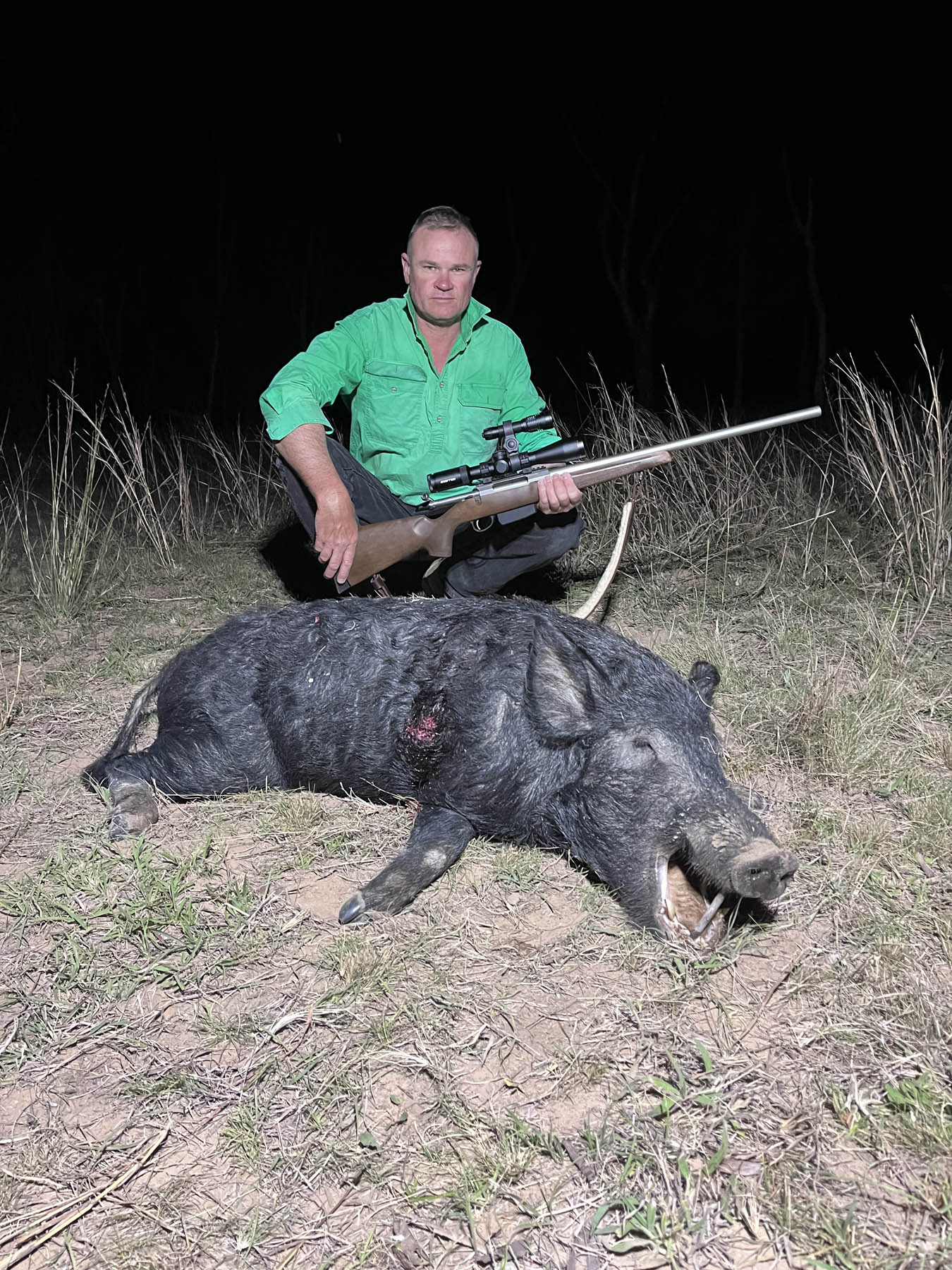
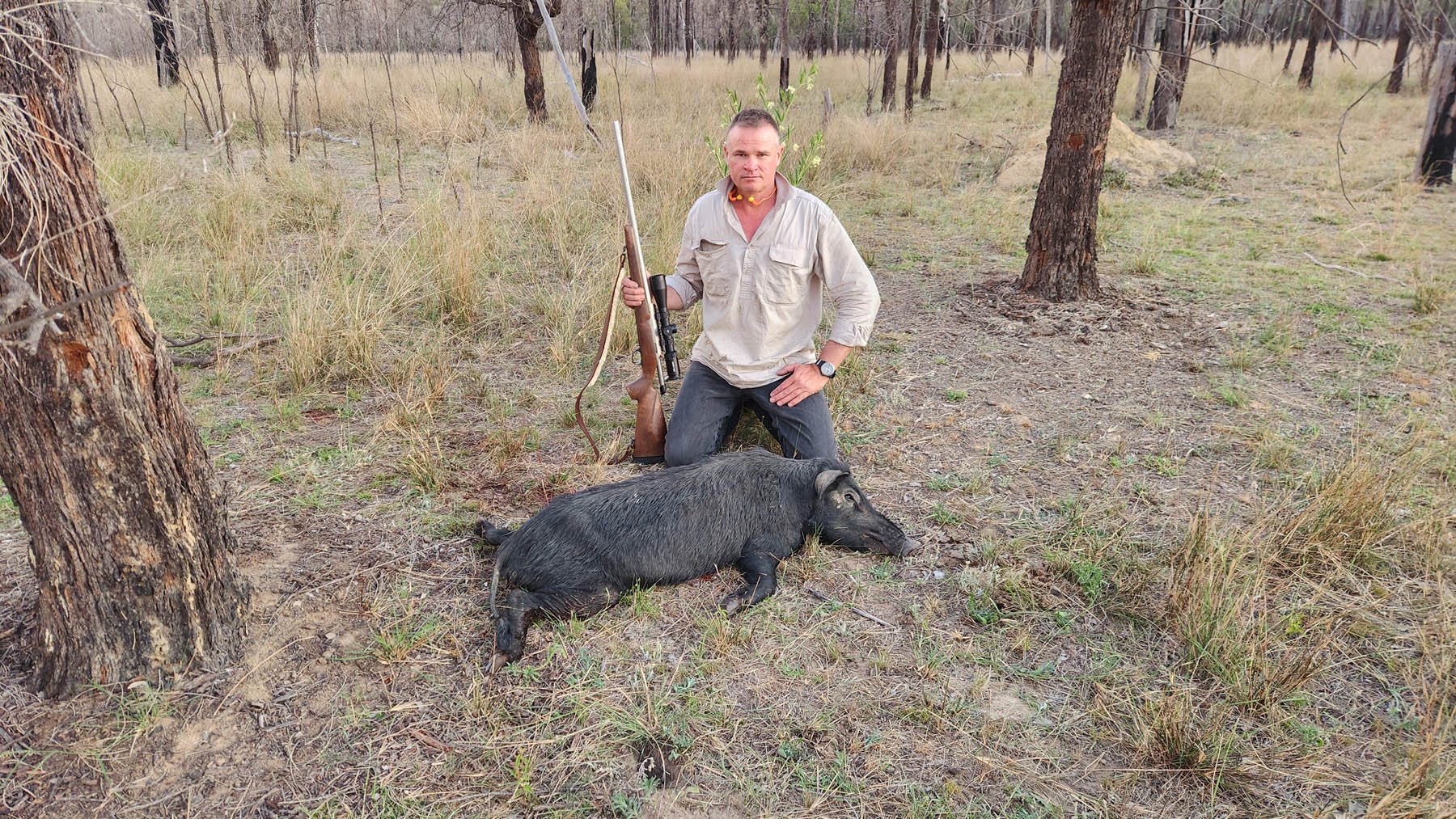
They were quicker than us but one unlucky sow couldn’t outrun the Creedmoor. I tracked her at pace and didn’t need the mil-dot aiming marks for this situation as I was confident with the running shot. A large boar was also unfortunate to cross our path on another occasion, as it tried to sneak into the darkness of thick scrub. I’d mounted a Nitecore flashlight to the scope and, despite the very dusty air, found the glass of the Thrive more than adequate in low light.
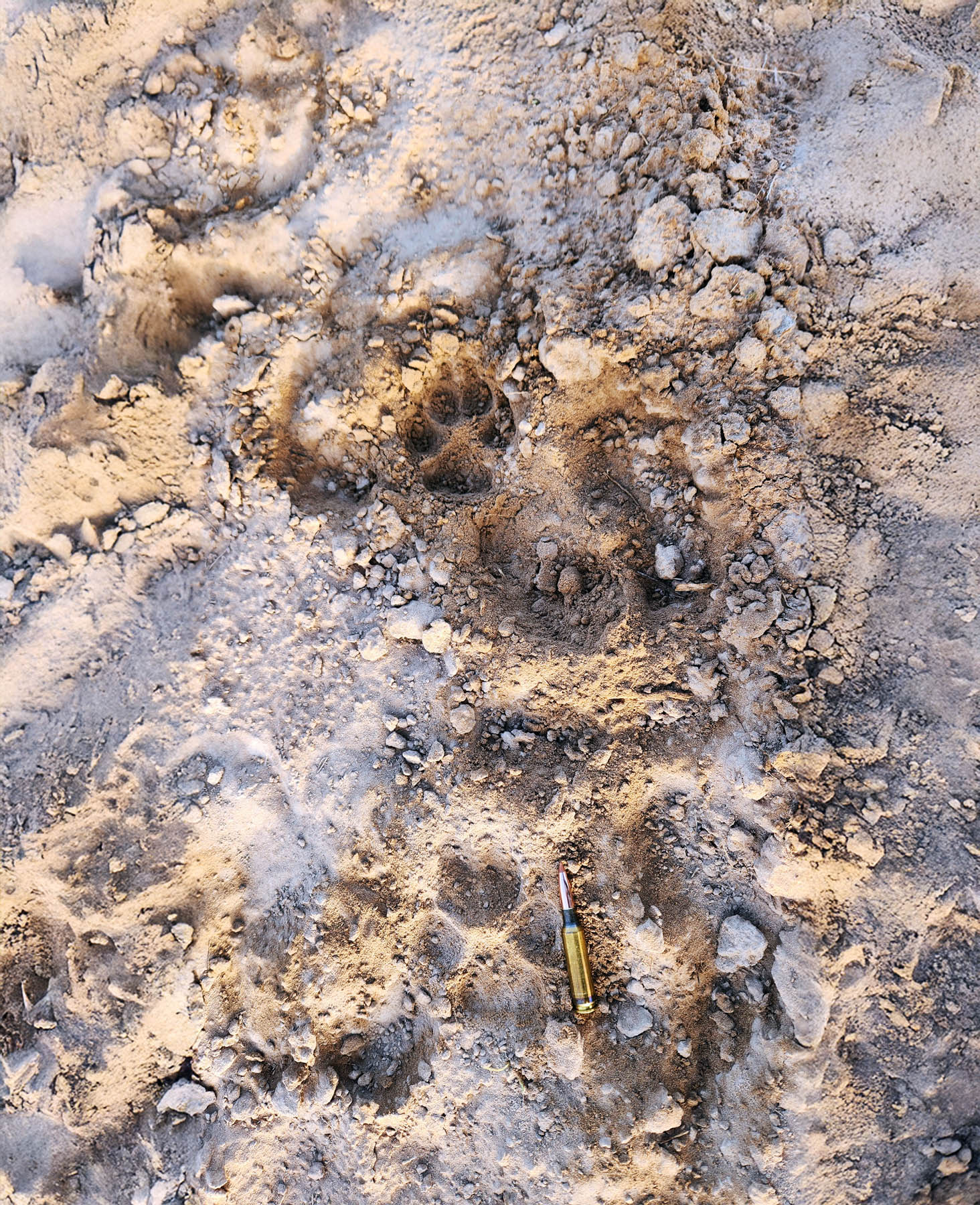
Wild dogs dominate the surrounding sandstone hills and another afternoon, Carl mentioned how he’d heard eery howls and felt as though he’d been watched as the sun disappeared. He decided to enjoy an extended pre-dawn snooze the following morning, while I chose to investigate a vocal raucous which had occurred during the night. Not more than a few metres from camp I found paw prints. Then more . . . big ones! The owners had assured me their baiting program had cleared the place of wild dogs, yet the evidence proved otherwise.
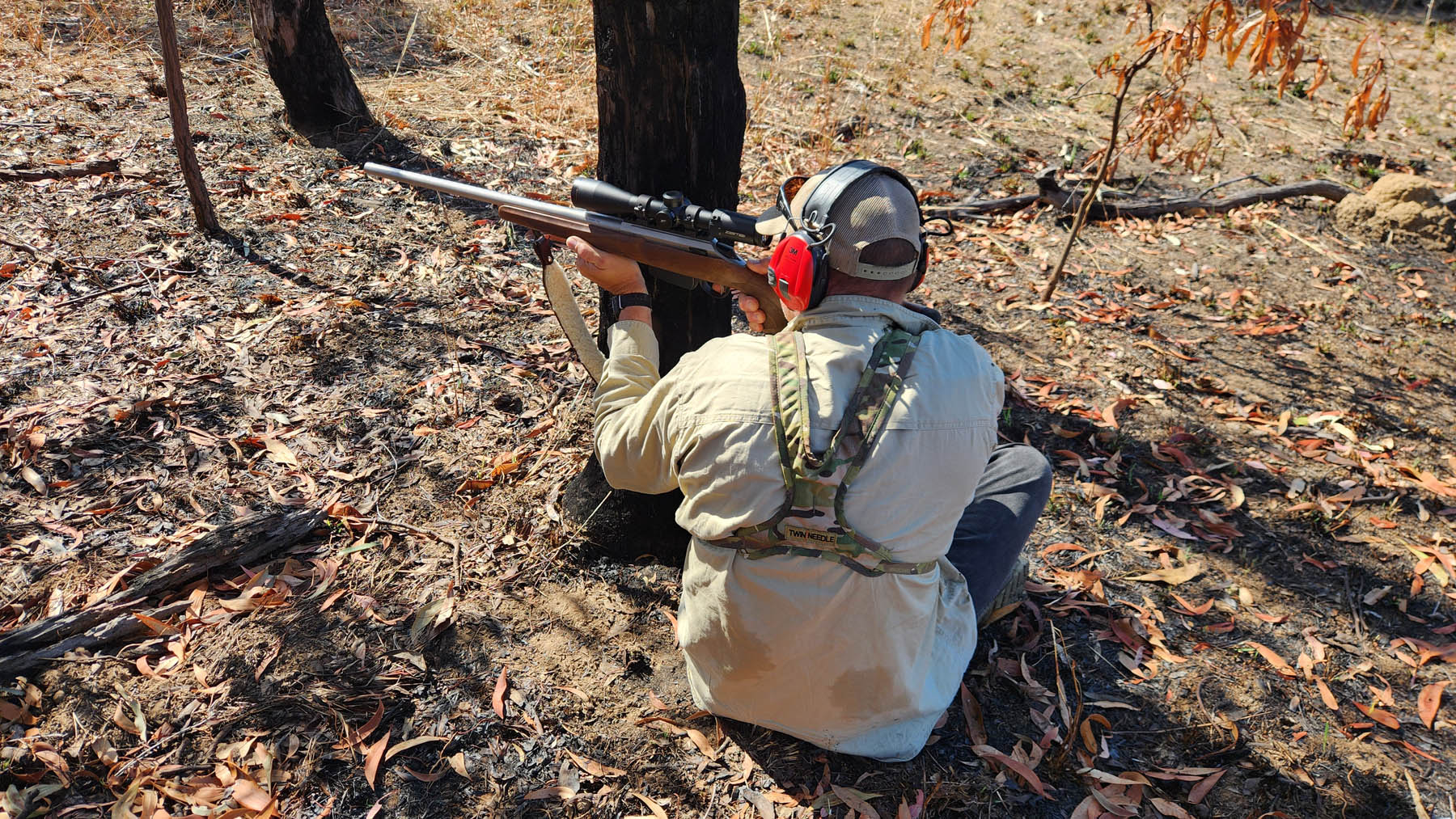
Too large to be the prints of our landlady’s Jack Russell and marginally bigger than the cow cocky’s Blue Heeler, the sneaky calf-killers had been making tracks in the dew-dampened earth back and forth from our camp. In the mist I was confused as to which direction to head so, upon sunrise, took up a vantage point high on a ridge at the base of a tree with a view of camp below. I bellowed some intermittent howls without response, while sitting patiently for 45 minutes until I thought I’d better head back to camp and get ready for work.
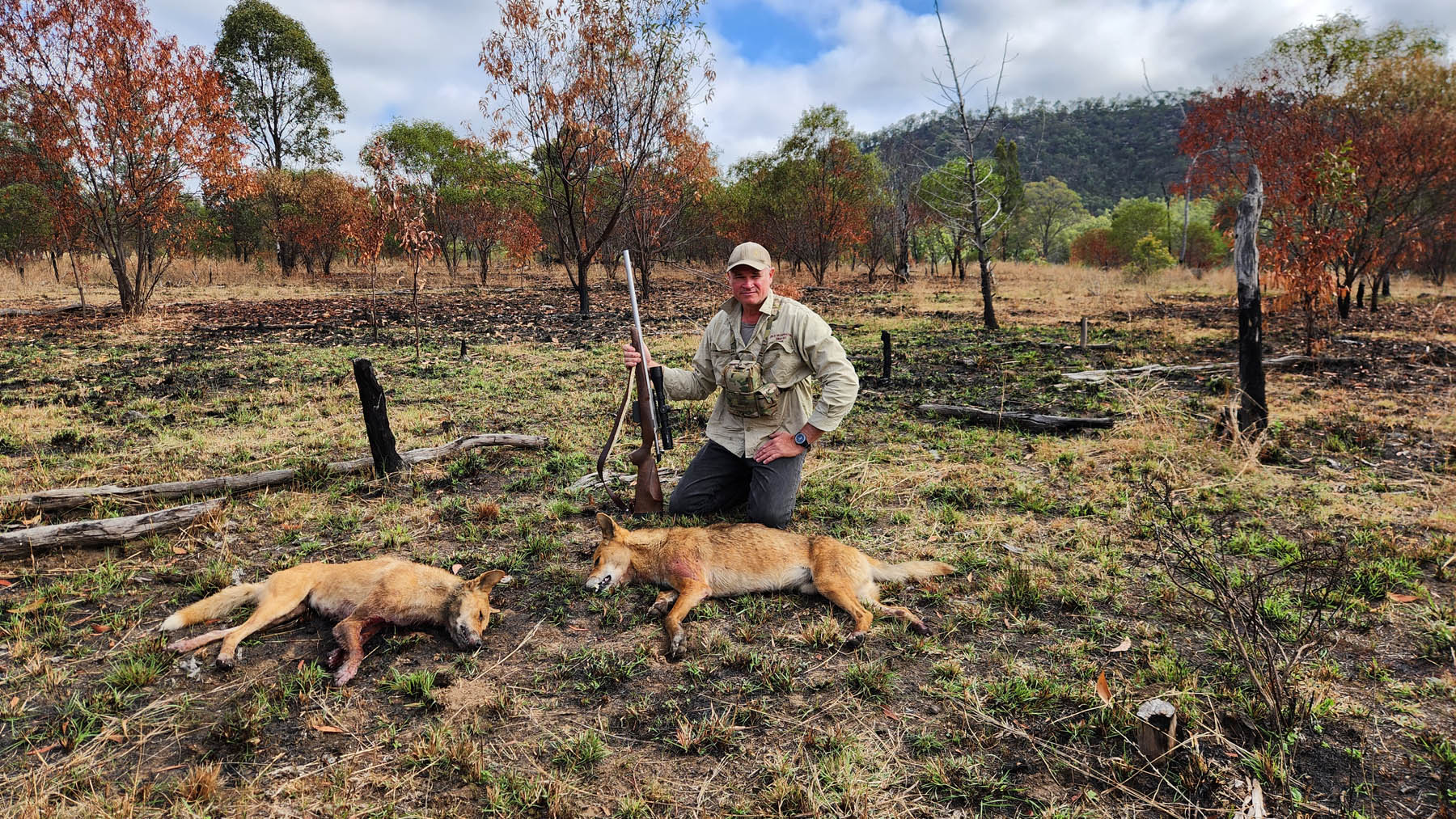
Suddenly my senses spiked as, running towards me from the fog, came a big dog with his head propped at full alert, wondering who was calling from his territory. I was in an awkward spot as he came in from the side and I needed a sight picture fast. Swivelling around the tree, I followed him with the mil-dot as he slowed to a suspicious walk to catch my scent and now completely to the rear of my original position, he paused briefly for a sniff. I dropped him on the spot at around 100m but, to my surprise, a bitch then emerged from the fog and also fell to the 6.5 as I heaved a sigh of relief.
I returned to camp with the good news as Carl cursed his decision to sleep in. The dogs didn’t go to waste and we took their scalps as a bounty, while the property owners were surprised yet happy we’d removed another threat to their valuable herd.
Wrap-up
During our field test I thoroughly enjoyed using the Thrive mounted to my Tikka. I wouldn’t say the mil-dot scope was used to its full advantage for long-range shooting during this review, but that’s hunting. Yet I know if the situation arose for a long shot I’d have the aiming marks to help get the job done, and reckon it would suit a long-range varmint rifle for shooting ferals in crops.
The scope worked well in other situations and for a glass retailing around $399 (at time of writing), it performed above its budget status. ZeroTech don’t hide the fact Thrive scopes are manufactured in China but, backed by their ‘any owner, any problem, always covered’ lifetime warranty, you’re guaranteed a bargain, especially hunters after a decent scope at a great price.
With the versatility of four reticle options and illuminated models also available, the Thrive 3-12×44 scopes will suit a wide selection of hunting rifles of varying calibre combos. For more on the ZeroTech range and local stockists, visit www.tsaoutdoors.com.au.