

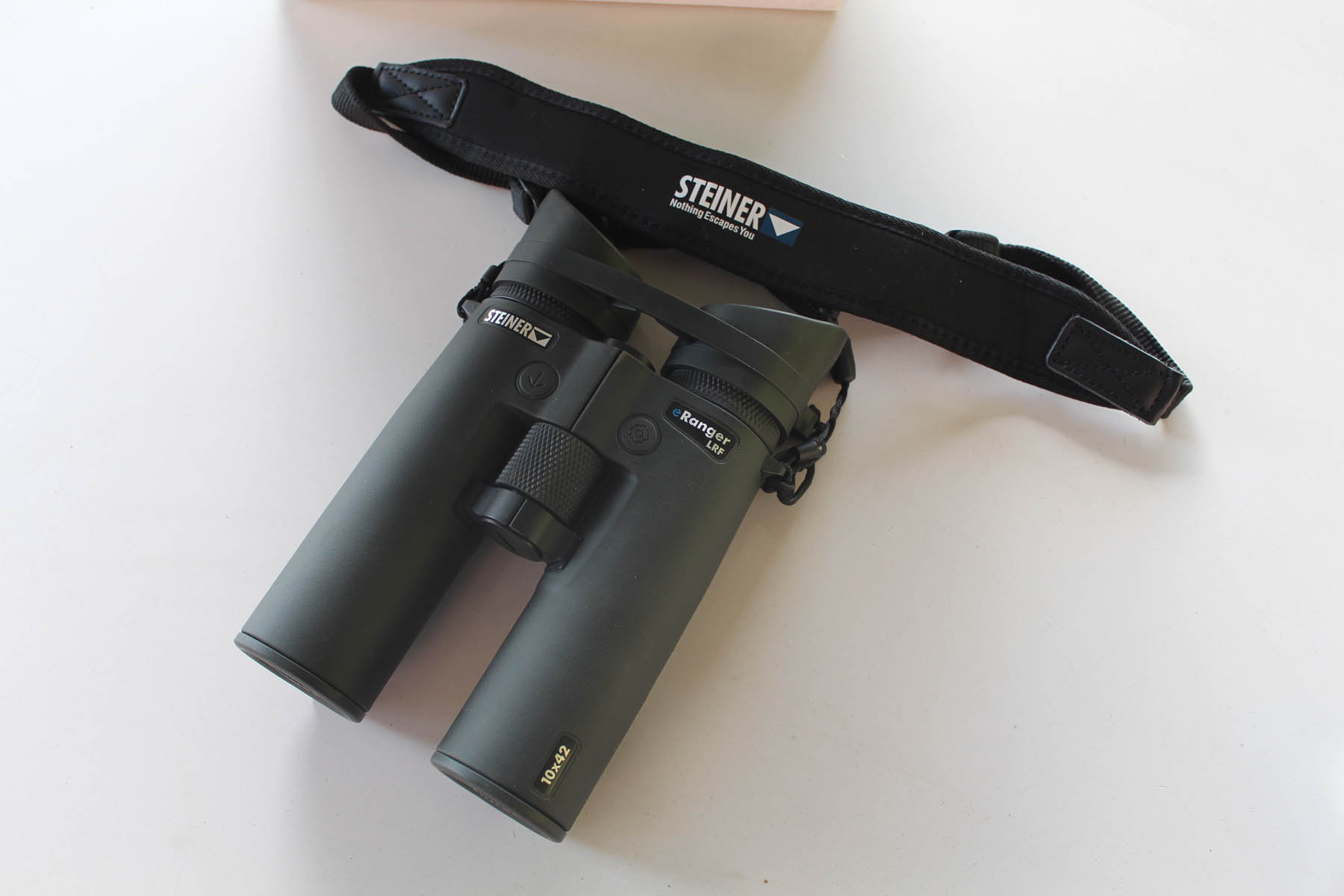
Hi-tech Steiner combo left Daniel O’Dea highly impressed
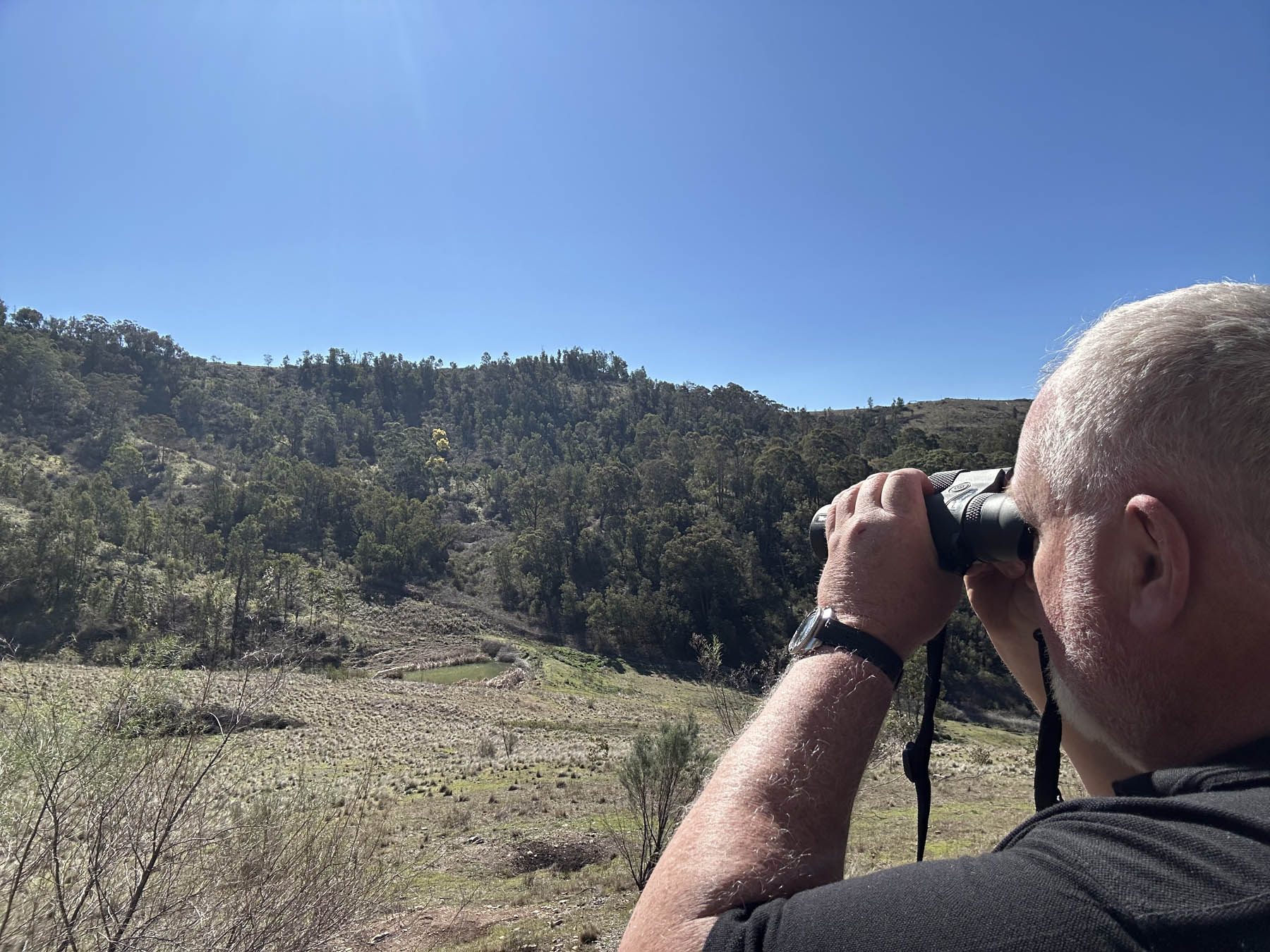
Picture yourself glassing across a gully to a face that’s heavily timbered, broken occasionally by a series of small open patches. It’s in one such patch you hope to spot your elusive quarry as it warms itself in the sun’s first rays. Your patience is rewarded when suddenly a stag appears. Trophy assessment is made easy as you view the beast through your new Steiner eRanger LRF binoculars, whose clarity and depth perception highlight the animal’s impressive features.
The decision to engage is quickly made but the topography prevents closing the distance. With your eRangers still up, you press a button to activate the rangefinding feature and a reading appears almost instantly. At 300m it’ll be a longer shot than preferred but your rifle and calibre choice are both up to the task. You’ve practiced, are prepared and have an edge. Your rifle’s also fitted with a Steiner, this time an eRanger 8 scope so there’s no question of ethics in taking the shot.
Preparation started weeks before when you sighted-in your Steiner eRanger 8 scope mounted to your favourite rifle. At the same time you uploaded ballistic data for your favourite loading using the Steiner app on your phone and that’s programmed into the scope. Back on the side of hill you’ve automatically transferred the range data via Bluetooth directly from your eRanger LRF binoculars to your eRanger 8 scope. Using the elevation turret on the eRanger 8 you dial up to match the range data transferred. But the scope hasn’t just matched for elevation, it calculated a ballistic solution including inputs for temperature, air pressure and inclination, the latter adjusting for true ballistics.
At this point it’s back on you, the shooter, but your rest is solid, rifle true and with Steiner eRanger you have the ultimate confidence that doing your job right almost assures the outcome. As the rifle kicks, your sight picture recovers in time to see the impact followed closely by the whack of a solid hit echoing across the gully. The stag crashes into the tree line just metres from where he last took in the sun.
Now for recovery. Back on the eRanger LRFs you can see your prize lying peacefully inside the tree line. It’s going to be an arduous track down and up through the scrub and won’t be direct due to both landscape and other obstacles. It’s obvious from here but without line of sight travel and no clear markers, locating your quarry might not be easy when you get there, if you can even find where ‘there’ is.
Luckily the LRFs step up as you view and mark the position from where you stand. Again the data is transferred, the Steiner app using Google maps imagery to guide you in with compass headings included. You’re there before you know it though unfortunately, Steiner hasn’t come up with a gut, field-dress or carry-out feature but they’ve certainly given you an edge. Of course the above is a work of fiction, created in my mind using collective memories of past hunting experiences. But it’s no fantasy, the technology is real and this example could just as easily play out in the field using these Steiner products.
Call me old-fashioned as I’ve been a slow adopter of electronic optics. But as Steiner themselves refer to this system as somewhat of a hybrid, you’ve the benefits of high-grade European glass with all the modern technology to make the most of it. When combined, the binoculars and scope work in unison and not just as described in my analogy. If hunting as a team, one as shooter and the other as spotter, the process could potentially be even more seamless.
eRanger LRF
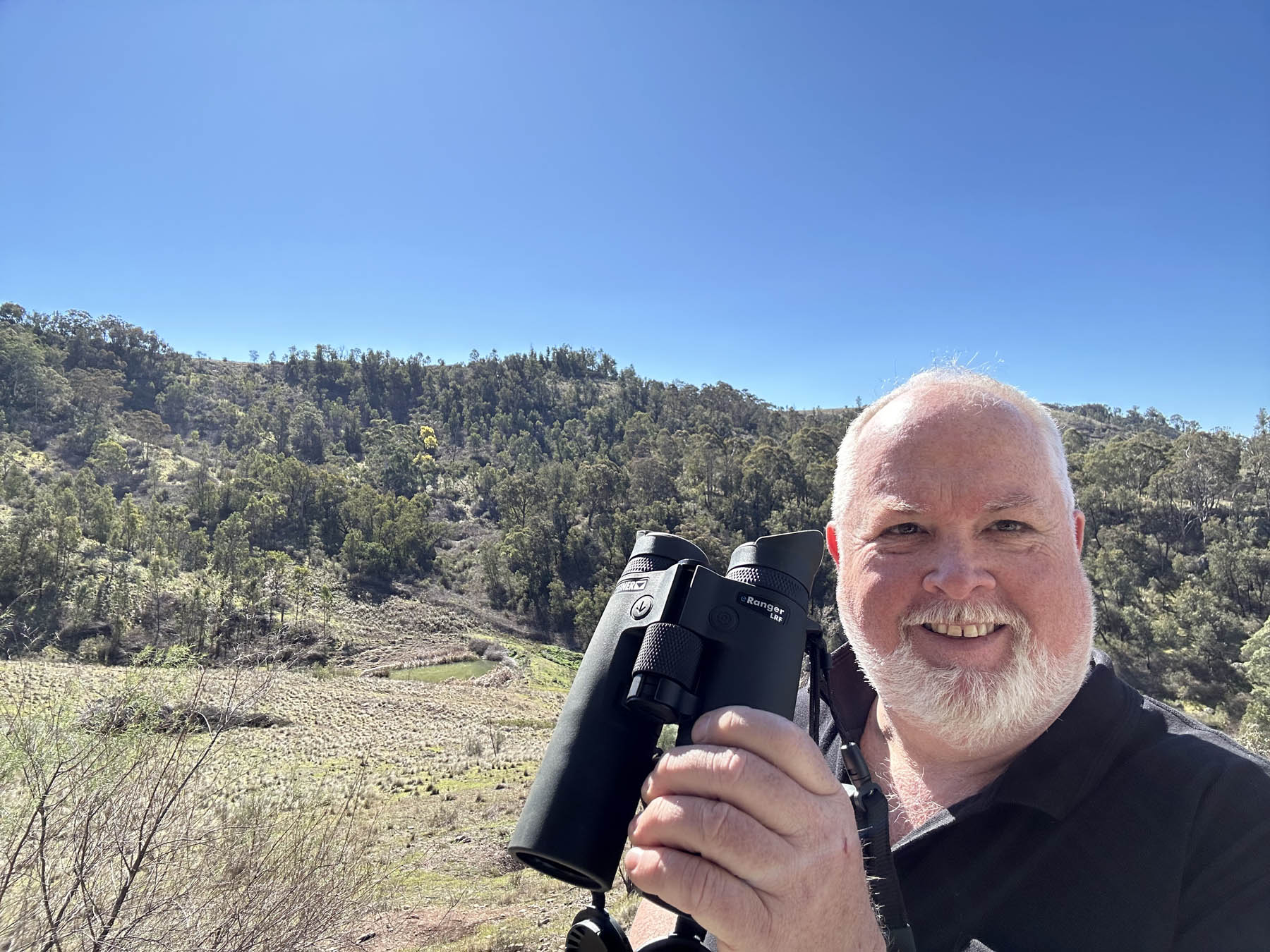
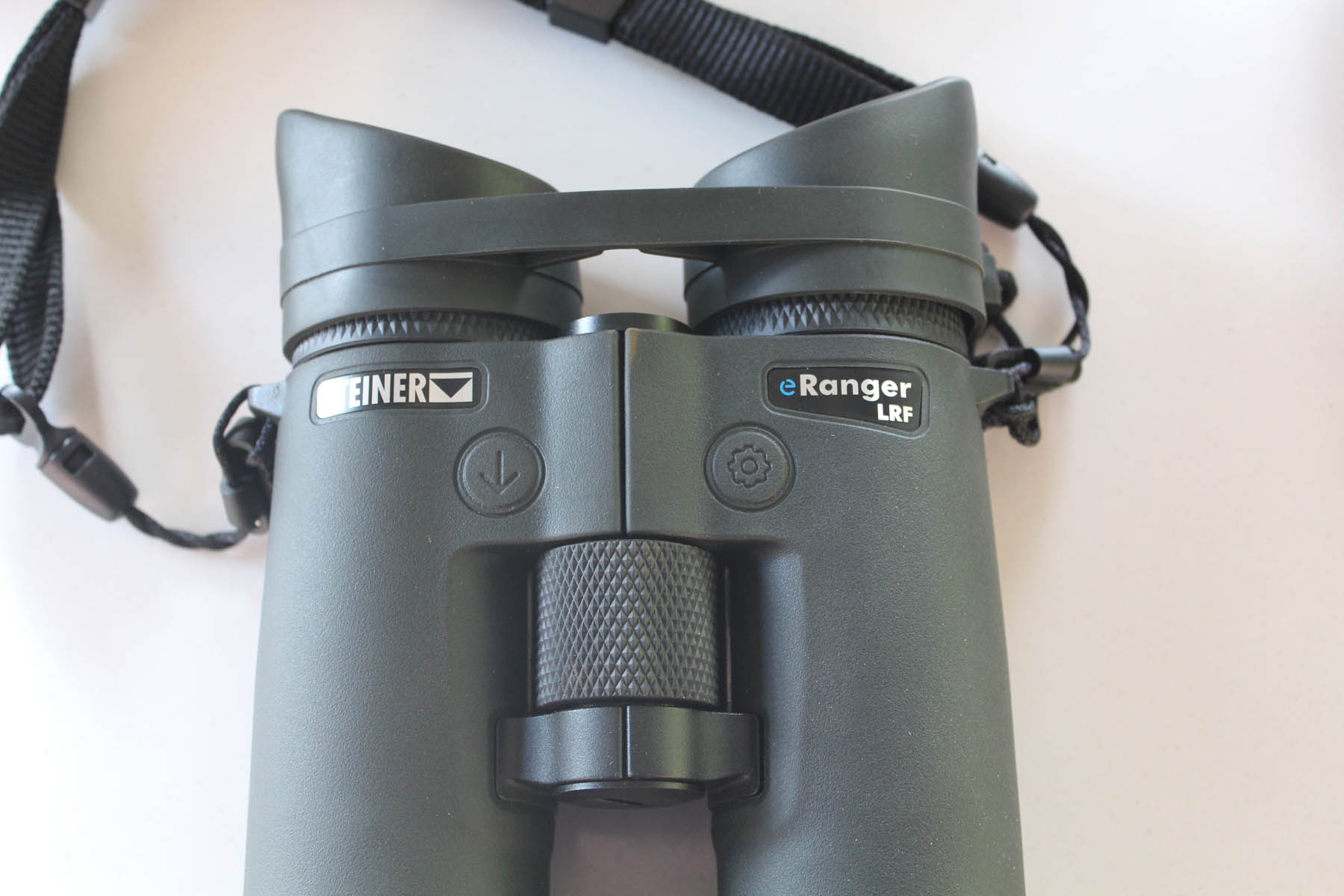
Taking a quick look at the individual products and with the eRanger LRFs, at first glance we have what would otherwise appear a pretty much standard-looking pair of modern roof prism-style binos, maybe a tad longer than some. But there’s some clever innovation trading into great ergonomics. For instance, the focus wheel is forward on the hinge as opposed to rearward, placing it more in the centre of balance when holding. Sounds a small thing but can help reduce fatigue when glassing for long periods. Likewise, controls are simple with two small rubberized buttons just rearward of the focus wheel controlling everything and easy to reach.
There’s diopter adjustment for both eyepieces, folding rubber side shades on the eyecups having matching lens covers for both. At the front the lenses are protected by push-in rubber covers which are hinged and cleverly clip into slots incorporated into the lens housing. These stay in place hanging below each lens when not in use, ready to pop back in when needed. In another clever move the single CR2 battery sits in the hinge body, accessible by a small screw cap at the front.
Base dimensions are 210mm long, 140mm wide and 56mm deep and they weigh 1.1kg. So it’s fair to say they’re not the smallest or lightest in class but how much size matters can be subjective against features and price when the difference is measured in millimetres and grams. I know weight can be an important factor in binoculars, yet I wouldn’t be overlooking these on that criteria alone. They come with a padded strap and Cordura carry bag for protection.
As indicated the eRanger LRFs are 10×42 in magnification with exit pupil of 4.2, light intensity is 85 per cent with a twilight factor of 20.49. Field of view is 105m at 1000m. They’re nitrogen-filled and rated for operation between -20C and +50C and, if you fall in the creek, make sure it’s no deeper than 1m and you’ll be fine. Distance measurement is significant from 25m to 3000m which is greater than most and everything’s covered by a 10-year warranty.
eRanger 8 3-24×56
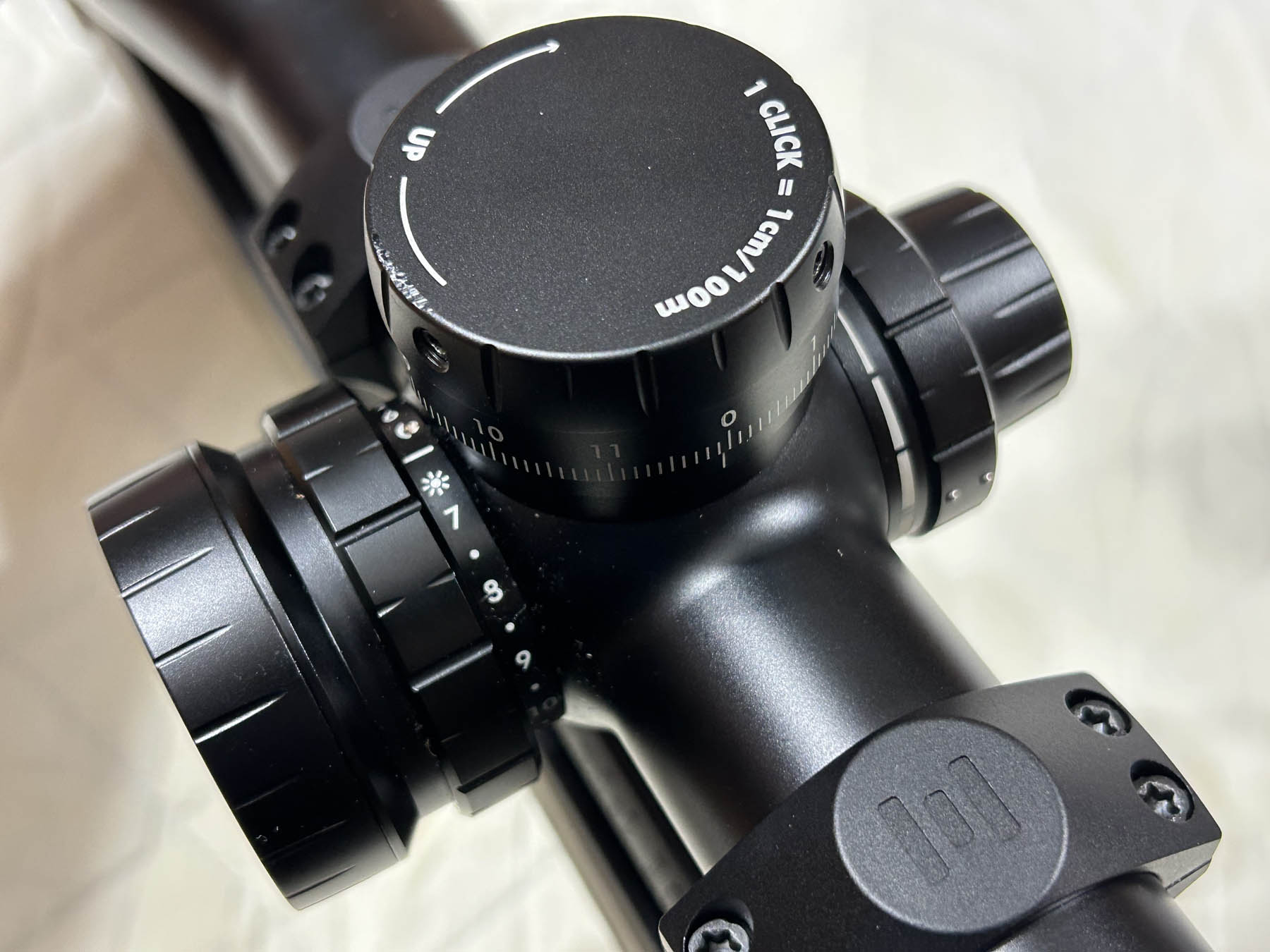
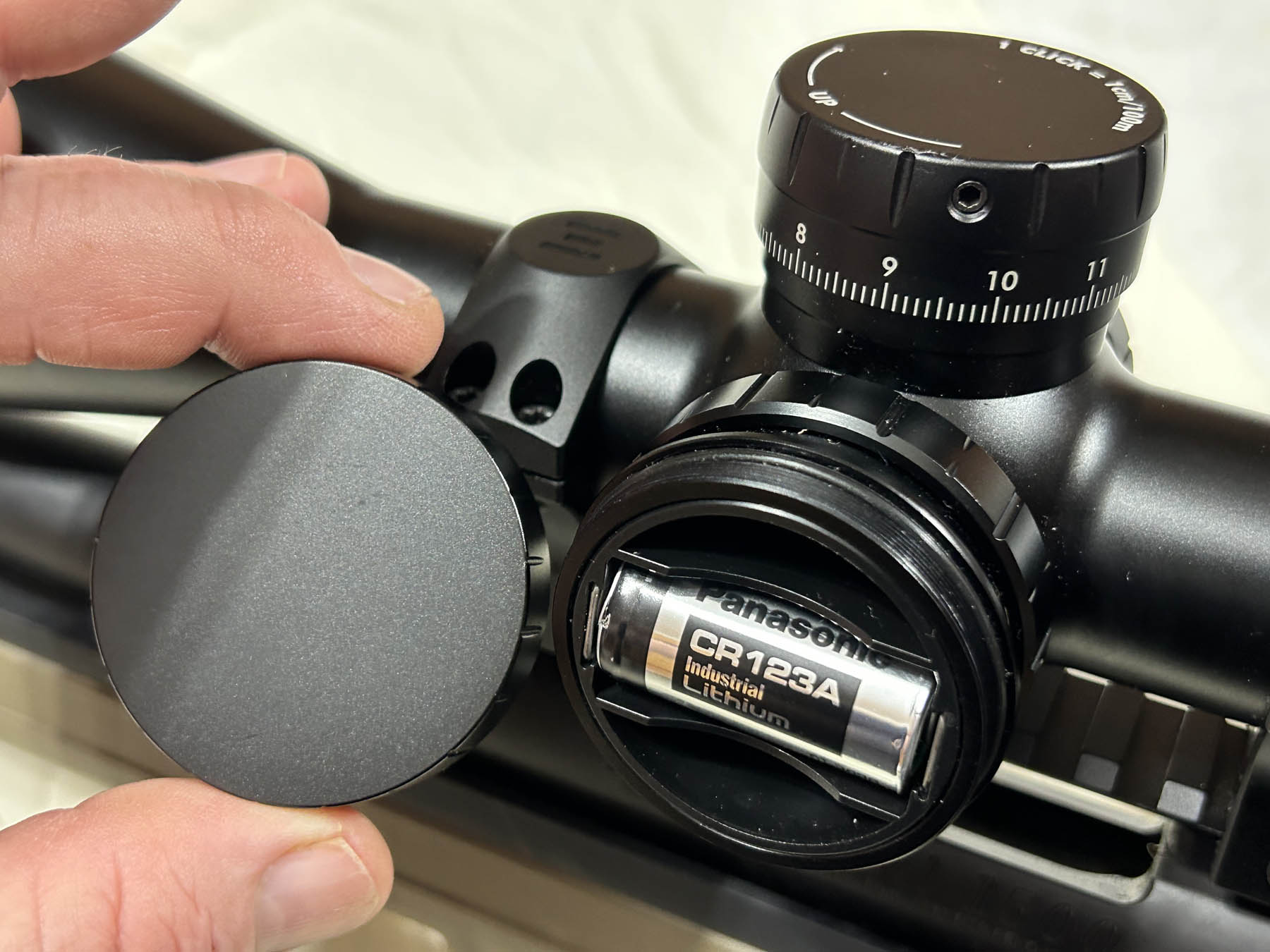
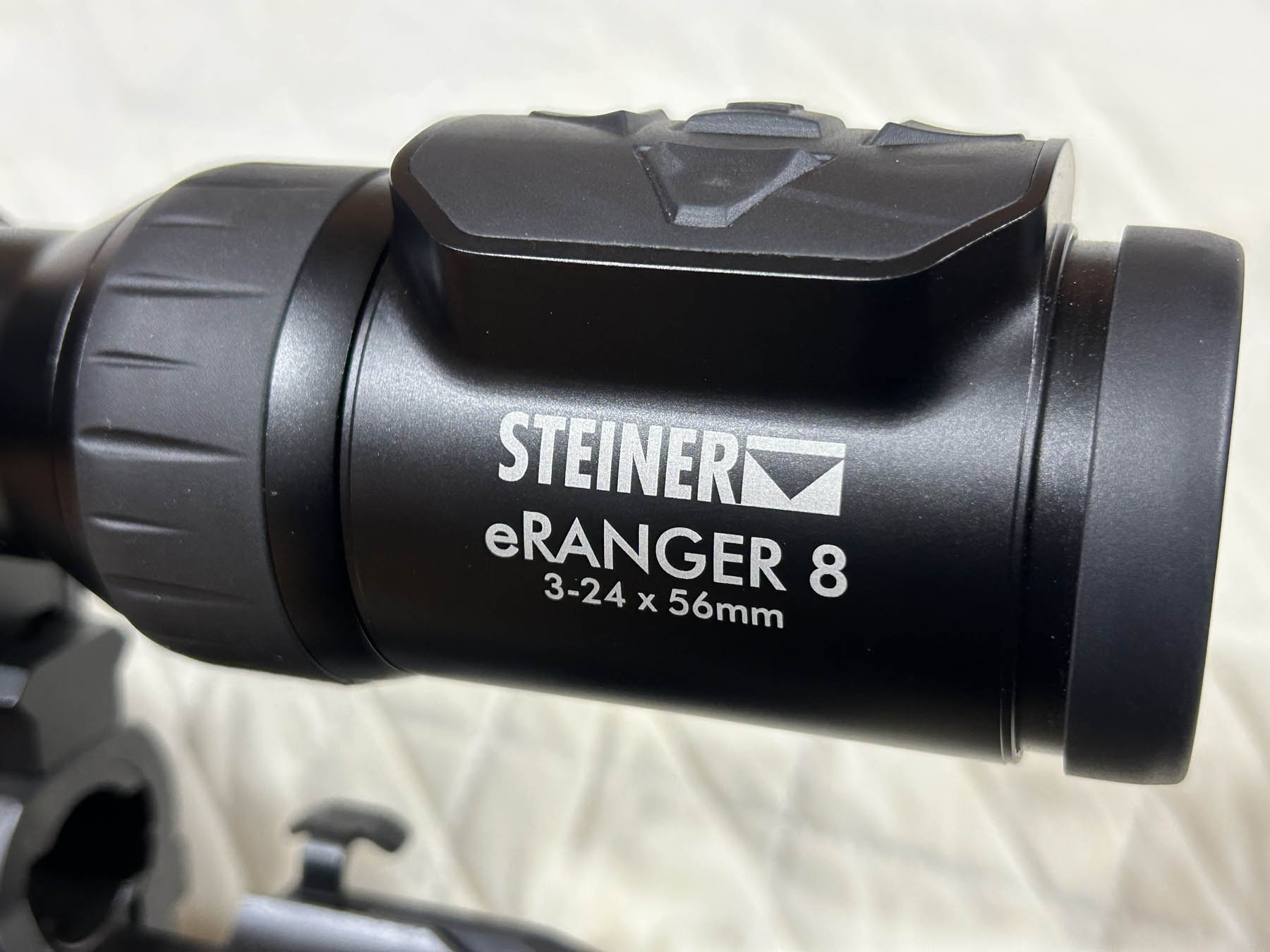
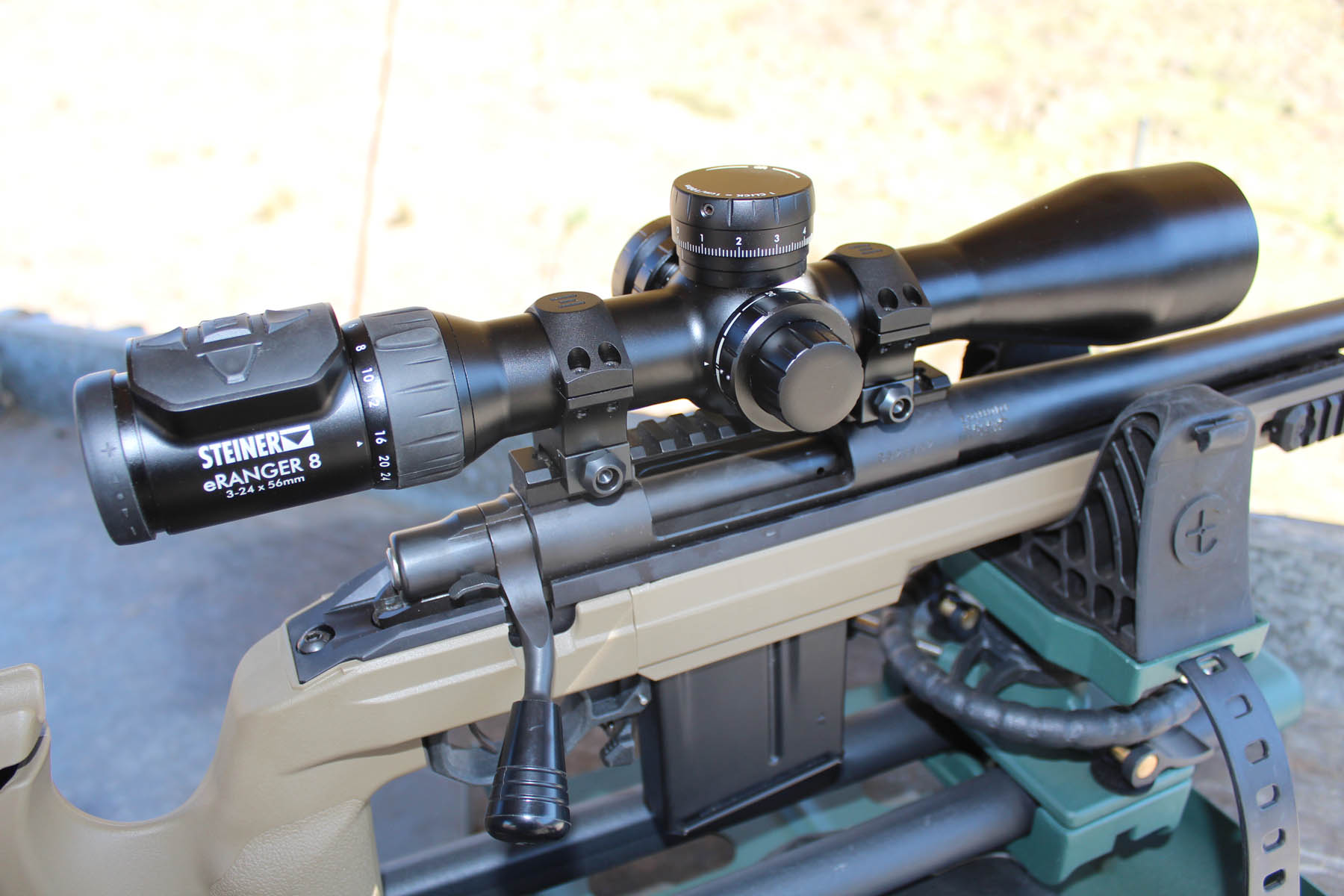
There are two variants of eRanger 8 scope, a 4-16×50 and 3-24×56 and I tested the latter. A fairly imposing unit with both a 34mm main tube and 56mm objective lens, it’s 385mm long and weighs just under a kilo. Three large turret towers dominate the centre and serve the following functions. Left has a large outer cap which screws off to reveal a compartment housing a single CR123 battery. An inner ring on the same turret provides 11 stages of illumination with an instant ‘off’ position between each setting, while the top turret provides elevation adjustment and has a zero-stop feature.
To set this the turret top has a couple of small grub screws, the zero stop aligning to the ‘O’ marking so, once sighted-in, just loosen the grub screws and align the ‘O’ on the turret with the zero on the tower base, retighten and zero stop is set. The right and smaller of the three turrets does windages and has an inner larger ring controlling parallax adjustment from 20m to infinity. All adjustment values have one click equalling 1cm at 100m (0.1 Milrad).
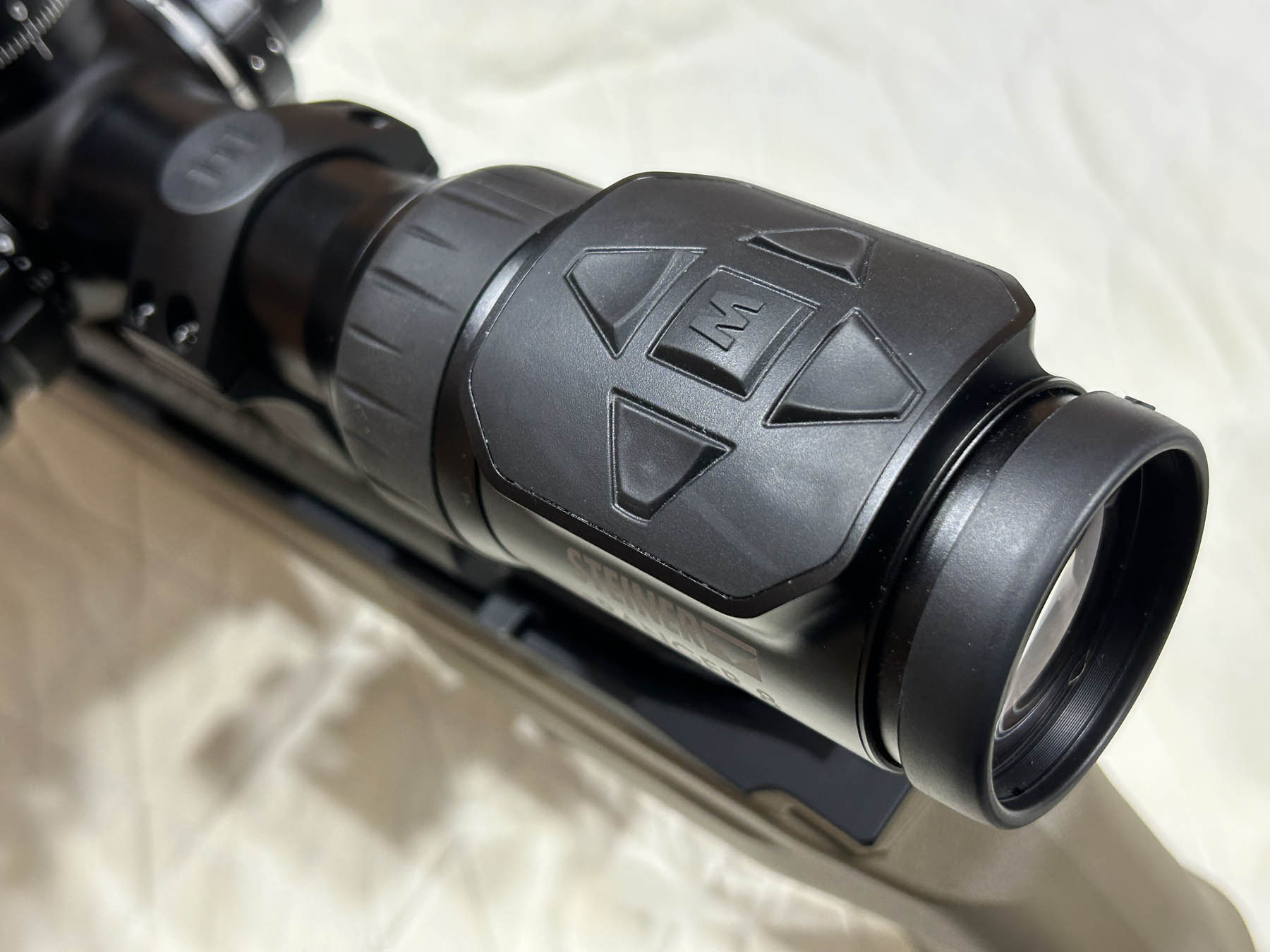
The ocular housing has a raised portion on top containing the controls and ballistic computer. Settings are adjusted using a cluster of rubberized buttons with four directional ones and a centre menu one which also acts as the power on/off. Just forward of this is the power ring for magnification adjustments, being wide and rubberised with raised ridges for positive grip.
With the 56mm objective the scope provides an exit pupil from 2.3mm to 8.5mm, the latter being about the maximum the human eye can process. Light intensity is rated at 90 per cent, field of view measures between 1.7m and 13.7m at 100m (highest to lowest power setting), diopter adjustment is -3/+2 and eye relief 95mm.
Like most new tech, at first it can seem a little daunting so here’s the rundown on basic set-up. Having downloaded the Steiner Connect app it’s easy to link both scope and binoculars via Bluetooth, the process no different to connecting your phone to the car audio. Turn the units on, place them near each other, the app finds the scope or binos and you accept the connection. Once in the app, devices auto connect when turned on and in proximity. In the app all your compatible eRanger devices are stored and conveniently listed.
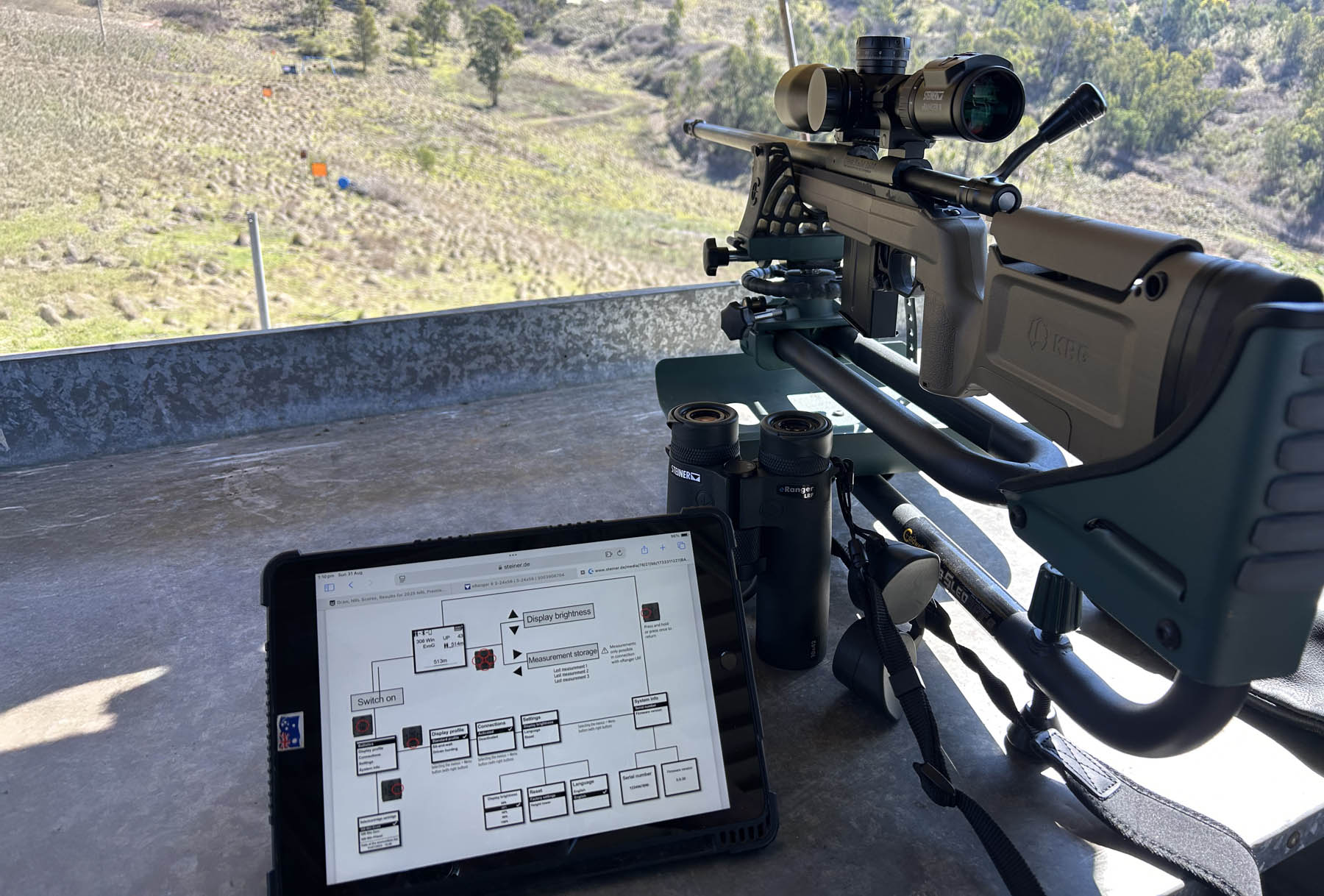
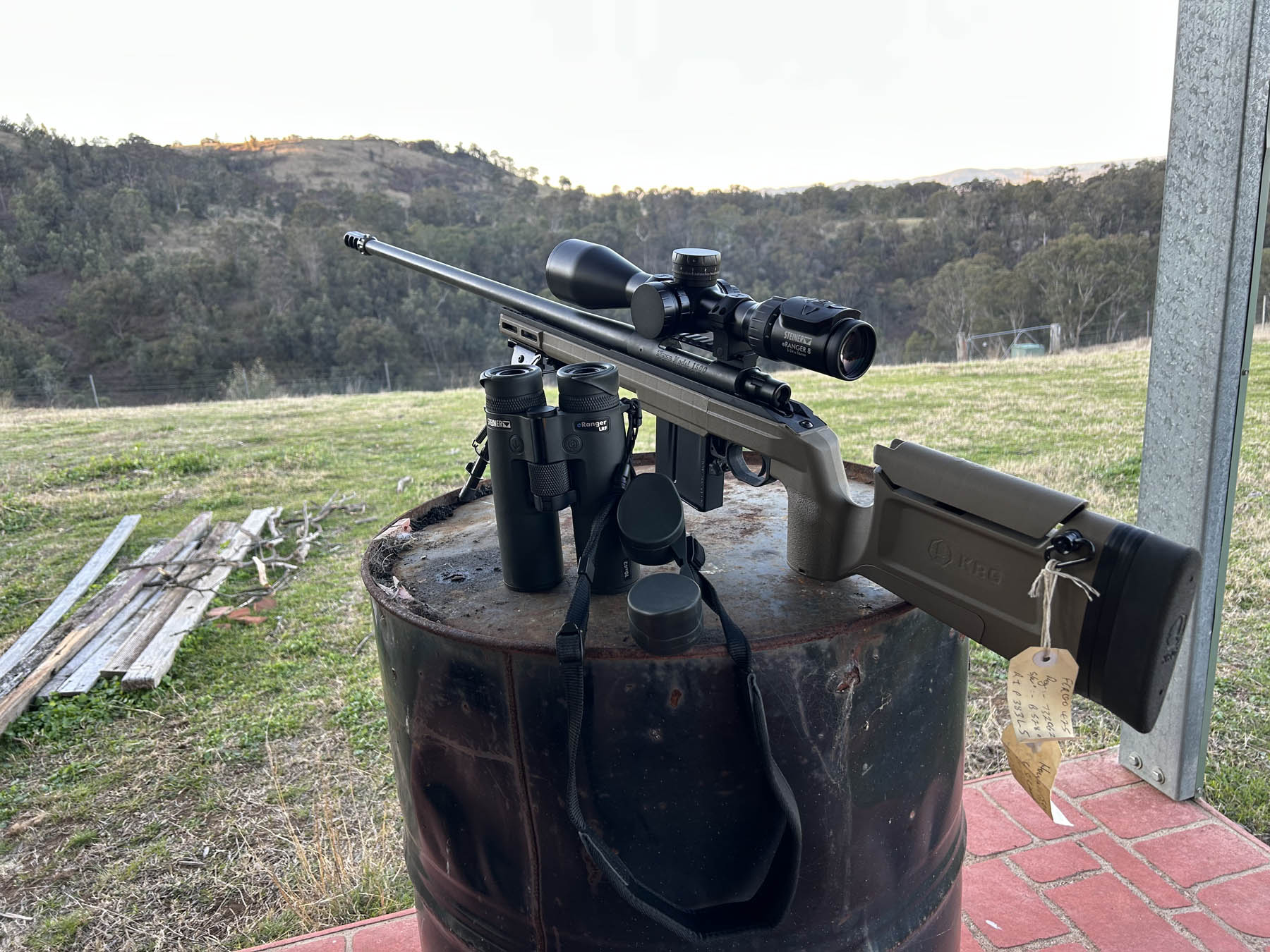
For testing I took my trusty KRG-stocked Howa in 6.5 Creedmoor fitted with GCDP muzzle brake, a superbly accurate long-range rifle I can rely on for testing such optics. I mounted the eRanger 8 using a set of rock-solid Element 34mm rings and was off to the range, sighting-in a breeze with the rifle locked in my Led Sled. With my first round on paper, I dialled both elevation and windage to the point of impact. Second round was 20mm high of the bullseye so two clicks up to cover the POI and the third round was in the bull then a fourth punched in beside it to confirm, the scope tracked perfectly. I’d note the optics are conventional so I’ve done all this with the scope’s clever electronics not even turned on.
Next is to program ballistics for the ammo I’d be using by creating an entry in my ‘Cartridge List’ on the app. This is a walk-through step-by-step process starting with naming the load then entering the zero range, bullet data, if factory ammo selecting brand and load by dropdown menu or if a hand load entering data manually, then finally muzzle velocity before saving. You can save multiple loads in the cartridge list.
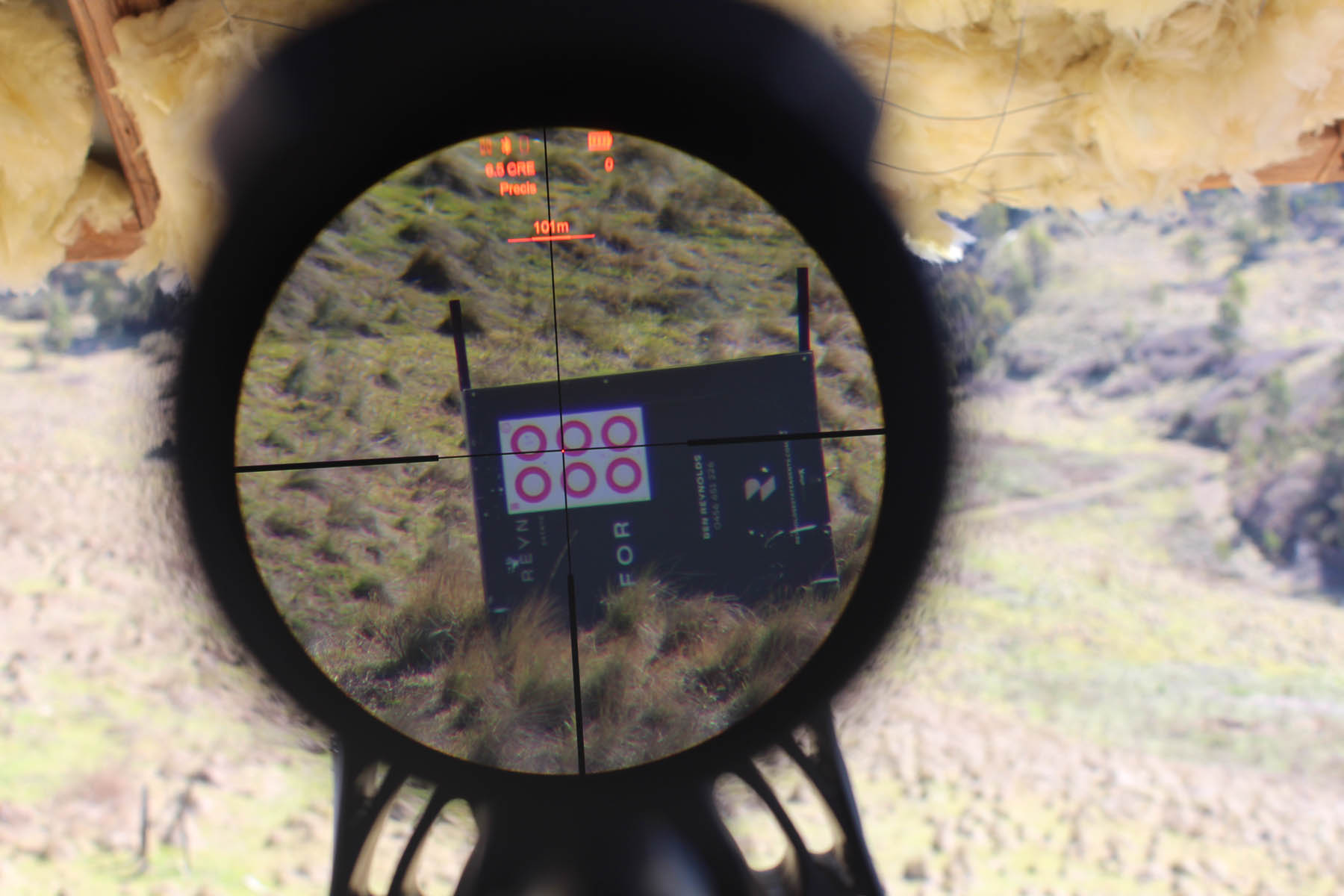
Still on the app you select the load you’re using from the cartridge list and, when the scope’s on and connected, it’ll ask you to confirm the turret is set to zero and press ‘ok’. With that done a small, illuminated information display above the reticle shows the current (zero) range setting, in this case 100m, ammunition selected, battery life, connectivity etc.
All sighted-in I first measured up some steel targets with the eRanger LRF, first reading came back at 235m, picked up my rifle and that same range now appeared in the display above and to the right of the zero reading. Moving to the turret, I start dialling up and the range displayed changes in unison until I reach the desired match at 235m. Fire, centre punch the steel, next target repeat and so on.
Late afternoon I set up on a veranda scanning the blackberry and scrubby hillside across the way in the still evening air. I was looking for ferals moving out of their beds and in and out of a few little clearings. A small pig comes into view, I range it at 258m with the eRanger LRFs to the rifle, I dial it up to match the measured distance and ‘bang’ – it rolls over. A second comes into view ranging at 381m so I repeat the process, dialling up the turret on the eRanger 8 until the zero matches the reading displayed and at the outcome is repeated with an instant kill. It almost feels like cheating!
Premium European glass isn’t cheap to being with, add such state-of-the-art technology and it’s not surprising the price rises. Yet on checking the Beretta Australia website, I was surprised to find the eRanger 8 as tested (3-24×56) listing for $4759 RRP and eRanger LRF 10×42 at $2499. I’m not saying they’re cheap by any means but, considering all the features, they could be considered competitively priced comparative to the market segment they compete in. More at www.berettaaustralia.com.au