
North to Alaska
by Bob Hart
Hunter 11
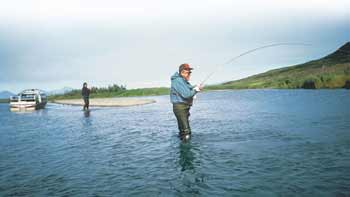
 The cold rain beat against my face as I waded across the clear grey waters of the Goodnews River.
“Over here, come over here,” came the cry from my friend, Ron, who was standing on the opposite side of the river. While I was climbing the steep grassy bank, he pointed to something in the water. When I arrived to where he was standing, I could hardly believe my eyes. There, swimming only a few metres from the river’s edge, swam thousands of silver salmon. We were breathless at the sight.
Recovered from the shock of this awesome spectacle, we began to cast our eight-weight fly lines. With short jerky retrieves, which gave maximum action to our fluorescent pink marabou flies, we were both soon fighting silver salmon. My fish ran 40 metres before it hit the air in a tumbling leap. No sooner had he landed, he went skyward again. This time when it landed, the fish headed directly for the middle of the river. Swimming straight downstream with the help of a very strong current, he was impossible to hold. I watched helplessly as my spool emptied at an alarming rate and I realised that soon the fight would be over, and there was nothing I could do about it.
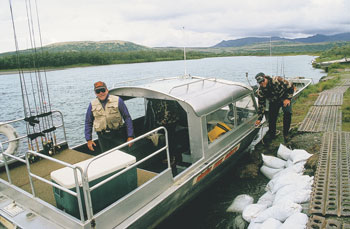
“Quick Bob, jump in the boat. We’ll chase him.” It was the voice of our guide, Toby, who had been carefully observing the action and knew I was in trouble. When I reached the jet boat, the engine had already been started. We sped after our silver gladiator and after a 40-minute battle of wills, the beautiful eight-kilo fish was mine.
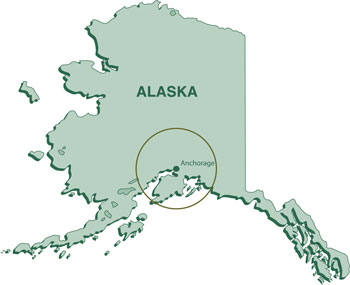
The adventure started when Dr Ron Woody and his wife invited me to join them on a fishing safari at the Goodnews River, West of Anchorage, Alaska. Every year, beginning about the end of June, the migration begins.
First to come are the largest salmon in the world - the king or chinook. Although these mighty fish can reach to more than 45 kilos, the average is about 15 to 20 kilos. A few weeks later the tasty sockeye and chum salmon, both averaging about four kilos, begin to appear. Last to enter the river, about early August, are the silver or coho salmon, which average five to six kilos.
It is a well-known fact that each fish will seek and find the exact spot in which it was hatched years previously. How the fish find this area is truly a mystery. After hatching and living in the river for a year or two, the young salmon head downstream where they eventually enter the freezing waters of the Bering Sea. Where they go from here is still unknown. After living at sea for two to five years, something alerts the fish into returning to its place of birth. Whether it is by magnetic bias or instinct, no-one knows how the salmon navigate to the river of its birth. Some experts believe that salmon have the ability to analyse minute mineral differences in water. However they achieve it, it is one of the wonders of the world.
While they are in saltwater, male and female all look the same. However, as they head upstream into the fresh water of the river, the males begin to grow a hooked top jaw, which continues to grow and deform until they spawn. Furthermore, once the salmon have entered the river, they stop feeding and only attack lures out of aggression. After eluding ravenous seals, voracious grizzly bears, fishermen’s nets and swimming against strong currents, the exhausted fish finally reach their destination. Here, the female constructs a gravel nest, where she lays her eggs. Just as a stag or bull will service a variety of females, so can the male salmon. After mating, the dissipated fish continue to deteriorate until death overcomes them.
Predators such as huge seagulls and colourful rainbow trout gorge themselves on the decaying carcasses that line the river. The flesh that has not been consumed provides nourishment for the next generation of young salmon and so the cycle of life begins anew.
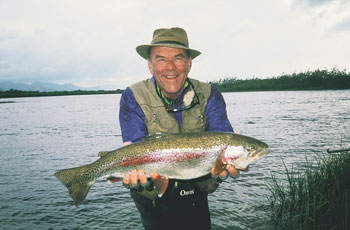
Feeding on freshly laid salmon eggs are beautifully coloured rainbow trout. Their metallic-gold backs and bright-red side stripes - together with a bright-silver side, is a sight to behold. Marauding Dolly Vardin chars, a fish similar to a trout, also feast on the banquet of eggs. Fortunately, enough eggs survive to ensure the species will survive with healthy numbers.
Every year thousands of avid fishermen from around the world flock to Alaska to fish for salmon, arctic and Dolly Vardin chars, rainbow trout, and grayling. The fishing is out-of-this-world in this unspoiled, chilly wilderness. It is so remote that sportsmen must fly in small planes to arrive at their destination. If visitors are lucky enough to fly in clear weather, they will witness tall snow-capped mountains, twisting glaziers and vast green tundras.
Even in the middle of summer, temperatures can vary enormously. Sometimes it can be teeming with rain with strong winds and a high of 7C or it can be a sunny 21C. Therefore, prudent fishermen go layered - prepared for any kind of weather.
Migrating salmon do not mind vile weather. One day, when I was having breakfast, I noticed the winds had picked up to 25-30 knots (46-55 kilometres).
“No-one can fly-fish in this weather,” I said. “And if anyone in this room can, I will polish and kiss their backside at high noon.” Almost everyone in the dinning room nodded in approval, except that is, my good friend Doc.
“Well, I can,” replied Doc, as he, his wife Laurie, and two other fishermen departed the comforts of the room to brave the rain and ever-increasing winds. As the day wore on, the wind increased from 30 to about 65 knots (120 kilometres). As the shrieking winds violently shook our large tent with ever-increasing ferocity, we all wondered about the safety of our friends. A few minutes before noon, we were relieved to see our wind-blown friends return to the safety of our cosy camp. They headed straight in front of me, turned around and bent over. Although I did not come good on my word, it did prove that on an absolutely vile day, you can still catch fish in Alaska, and that is saying something.
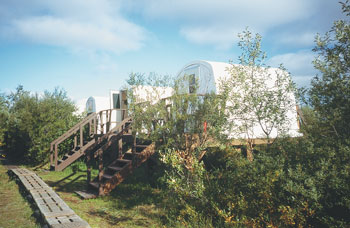
Our camp consisted of 11 two-man habitats, which were connected by a raised boardwalk to a main dining room/kitchen/bathroom complex. Propane gas heaters heated every habitat, including a drying room for clothes. All habitats are built on 1½-metre-high wooden platforms, ensuring that everything is kept dry from the soggy permafrost ground. Probably the greatest luxury of all was the hot shower at the end of a hard day’s fishing. A change into clean clothes and it was off to the dining room for drinks and entrées of fresh grilled salmon fillets.
While relaxing in camp one night, someone told us a wild story about a Japanese tourist who had been fishing on the Kenai Peninsula, which is a wilderness reserve noted for its superb salmon fishing and its large population of huge grizzly bears. The tourist had caught a magnificent salmon, which was destined for the taxidermist. With his splendid trophy slung over his shoulder, the triumphant angler began his way back to camp. He hadn’t gone very far, when a hungry grizzly spotted an easy meal. Swiftly, the ravenous bear closed the distance and pounced on our unwary fisherman. Pinning the frightened angler to the ground, the grizzly finished his tasty salmon meal and slowly departed - leaving a dazed and shaken Japanese gentleman wondering what the hell had happened to him.
Yes, Alaska is one of the few remaining wilderness left in today’s crowded world. A place where high adventure, big fish, and tall tales abound.