
Collector's logic
by Geoff Smith
Australian & New Zealand Handgun 2
 A recently devised and thought-provoking concept, in relation to handgun collecting, has been the ‘proper thematic structure’. The relevance of a particular collection should be based upon some type of logical thread that connects each component of the whole intellectually and motivates the collector to extend and make improvements. Finding such a thread begs the question of why it should be necessary in the first place, unless the reasoning is purely bureaucratic. In many ways it is like the issue of having to justify hunting, most genuine reasons for which have been lost in the mist of time.
Many items engage collectors without there necessarily having ever having been a clear reason (except, perhaps, to other similarly-minded collectors). To have to offer justification raises some curious philosophical and psychological questions. Logic suggests this recent need to explain simply arises because there has to be some point of origin for anything new. “We have to start somewhere!” we often hear from such folk. Perhaps we should ask them to explain why.
In New Scientist’s penultimate ‘Feedback’ page of March 13, 2004 (which column often highlights silliness), it was reported that on the whiteboard in a mathematician’s office, was the statement: ‘two does not equal three, even for very large values of two’. This confirms that there is a certain logic in even the least logical of ideas.
Society has nothing to fear from law-abiding citizens. Conversely, a criminal with murder in mind is hardly likely to consider the age, calibre or magazine capacity of his weapon. (And, of course, for this use, it is a weapon.) Similarly, from the victim’s viewpoint, there can be no degrees of ‘dead’. Notwithstanding this, however, legislation now poses much heavier restrictions upon those of us who wish to collect, study and display handguns.
To enable the acquisition of post-1946 handguns by collectors, most states have proceeded to enshrine into legislation, the concept of the ‘student of arms’. The criteria by which one might obtain such recognition is to have been involved in collecting for a minimum qualifying period, to have been accepted as a member of a recognised firearms collector club for a certain time, to have written or presented one or more publications or posters representing a contribution to the general body of knowledge about firearms and to have a minimum number of pre-1946 handguns in a collection that has an acceptable thematic structure.
Our previous question of why people might seek to collect firearms provides an interesting theme in itself. People usually tend to collect those items that they find attractive for some reason. Now we have to give much more consideration both to the reason and to the why. What really are the motives? It is obvious that firearms are more attractive to men than to women. Certainly, very few men would openly admit to collecting fluffy toys, knitting patterns or Barbara Cartland novels. Less obvious is why this might be. Is it still politically incorrect to suggest men are more mechanically minded than women?
A desire to understand could compel people to collect. There is likely to be a geographic and perhaps historical motive in why a person might collect, say, postage stamps or coins. There is usually a serial theme in items that are produced over time. Having obtained one, the collector might then seek earlier or later variations, or perhaps variations within a particular range of the one issue. Doubtless the same applies to firearms. A collector might set out to obtain a representative example of each model produced within a particular time-frame. With military firearms it could as easily be the event in which it was involved. The pistols of the Australian Army since federation could be an interesting theme.
Just as likely though, is the evolution of a particular idea. Browning’s self-loading pistols are still in production after more than a century. Many outstanding models have been made, and many more copied. It is a curious paradox that being unsuccessful is often a key to the desirability of particular firearms by the dedicated collector. Something that wasn’t really successful, and thus didn’t get made in very large numbers, is obviously a rarity. An extension of this is the unsuccessful prototype that eventually evolved into something very popular.
Thus we find that Hugo Borchardt’s clumsy, fragile and difficult-to-manufacture semi-automatic pistol, which Georg Luger later developed into the ‘pistole 1908’, more commonly known as the ‘Luger’, is now worth an absolute fortune. There were, according to Ian Hogg, only 2000 of them made (The New Illustrated Encyclopedia of Firearms, Quarto Publishing, London 1992). Even the early military (ie, pre-1908) Lugers and some of the commercially made models are very hard to come by and thus extremely expensive.
Militaria collectors often seek firearms with a personal history. Sometimes such pieces turn up with inscriptions engraved on them. A .455 Webley from the Great War is an interesting piece, perhaps worth a few hundred dollars in good condition, but if it is engraved with the original owner’s details and perhaps accompanied by other items, such as holsters, medals or photographs, letters, discharge papers and suchlike, the value sky-rockets.
It is likely that engineering is one of the main keys to themes pursued by firearm collectors. The time-frame during which modern firearms (by which we usually mean smokeless cartridge firing guns) have emerged gives a wide variety of such thematic structures. It is no coincidence that the appearance of smokeless propellant occurred simultaneously with repeating firearms and the mass production of machined metal devices. The electronic marvels of the past few decades are a later link in this exponential growth of technology.
It is approximately 600 years since the first real firearms appeared. It took more than 400 of these loops about the sun before the smouldering match gave way to the pyrites and serrated wheel, thence to flint and finally to percussion cap. Ignoring doubles and the curious Puckle flintlock machine-gun, essentially all of these innovations occurred in the single-shot muzzleloader. The interlinking of engineering, metallurgy, standards and chemistry all conspired to produce an initially military weapon that could be readily used in all weather conditions to reliably and consistently kill the enemy at long ranges and in increasingly large numbers. This, of course, also led to the improvements we see in handguns both for military and domestic purposes.
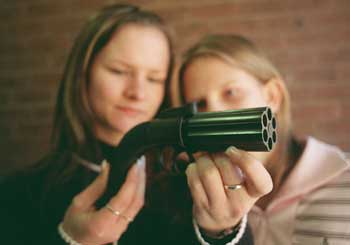
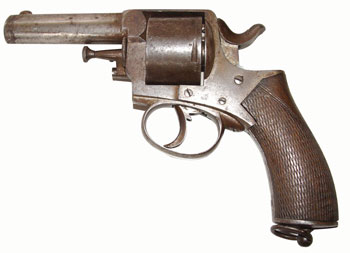
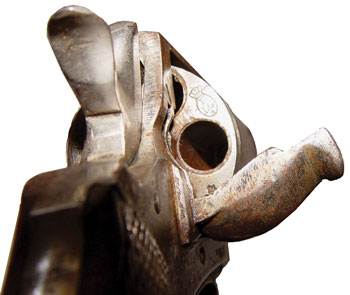
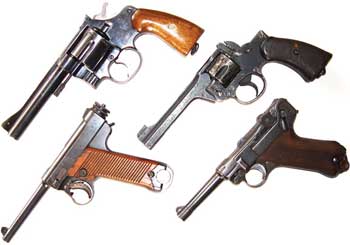
In the first 50 years of breech loading handguns, there is a rich field of examples of both successful and not so good prototypes of those we now take for granted. The photographs accompanying this story include some examples of themes and variations. There are groups of solid-frame revolvers and some with hinged frames. Their places and dates of origin differ widely. It is possible to have a theme of design linking one group and then perhaps a cross link of geography, or yet another of history that ties different pieces together in a larger group that at first sight might seem totally unrelated. Themes or otherwise, however, a study of the development of firearms over the past few hundred years gives a fascinating insight into the growth of human ingenuity.